Physical Address
304 North Cardinal St.
Dorchester Center, MA 02124
Physical Address
304 North Cardinal St.
Dorchester Center, MA 02124

You have a large yard — three, four, maybe six acres. You have already tried a standard push mower, and the weekend hours it consumes are wearing you down. You may have even looked at a robotic lawn mower before, only to find that most are designed for tidy suburban lots less than one acre. They map a single zone, avoid slopes, and stop dead in wet grass. What you actually need is a machine that treats your property like a real job — not a toy. That is the problem YARBO claims to solve with its modular, tracked, RTK-GPS-driven platform. We bought the Lawn Mower Pro and Snow Blower combo, unboxed it, assembled it, and ran it on a 4.7-acre property for one month. This YARBO robot lawn mower review is the result of that testing. Our goal: help you decide if this machine is the labor-saving investment it claims to be, or if your money is better spent elsewhere. If you are on the fence about spending nearly six thousand dollars on a robot mower, you need real data. See if YARBO robot mower is worth buying based on our findings, or read our Greenworks 80V review for a more conventional alternative.
At a Glance: YARBO Robot Lawn Mower Pro and Snow Blower
| Overall score | 7.2/10 |
| Performance | 7.8/10 |
| Ease of use | 6.0/10 |
| Build quality | 8.5/10 |
| Value for money | 6.5/10 |
| Price at review | 6479USD |
The YARBO impresses with rugged build and serious slope capability, but the setup complexity and app reliability hold it back from being a true set-and-forget solution for everyone.
The YARBO is not a typical robot lawn mower. It belongs to the category of heavy-duty, all-terrain robotic utility vehicles — a niche that currently includes only a handful of serious options. The three genuinely different approaches on the market right now are: boundary-wire mowers (like Husqvarna Automower), vision-based mowers (like Segway Navimow), and RTK-GPS tracked mowers (like YARBO). YARBO sits firmly in the third camp, adding a modular system that swaps between mowing, snow blowing, and leaf blowing decks.
YARBO, the manufacturer, is a relatively new entrant in outdoor power equipment. Their specific claim with this model is that it can handle up to six acres, climb 70 percent slopes using patented tracks, and switch tasks without buying a separate vehicle. That combination does not exist at this price from any established brand. We decided to test it because the modular promise is compelling: if one robot can do lawn care and snow removal, the value proposition changes entirely. We were skeptical. We remain skeptical but informed. For a deeper dive on the company’s claims, read YARBO’s official product page for their technical specs.
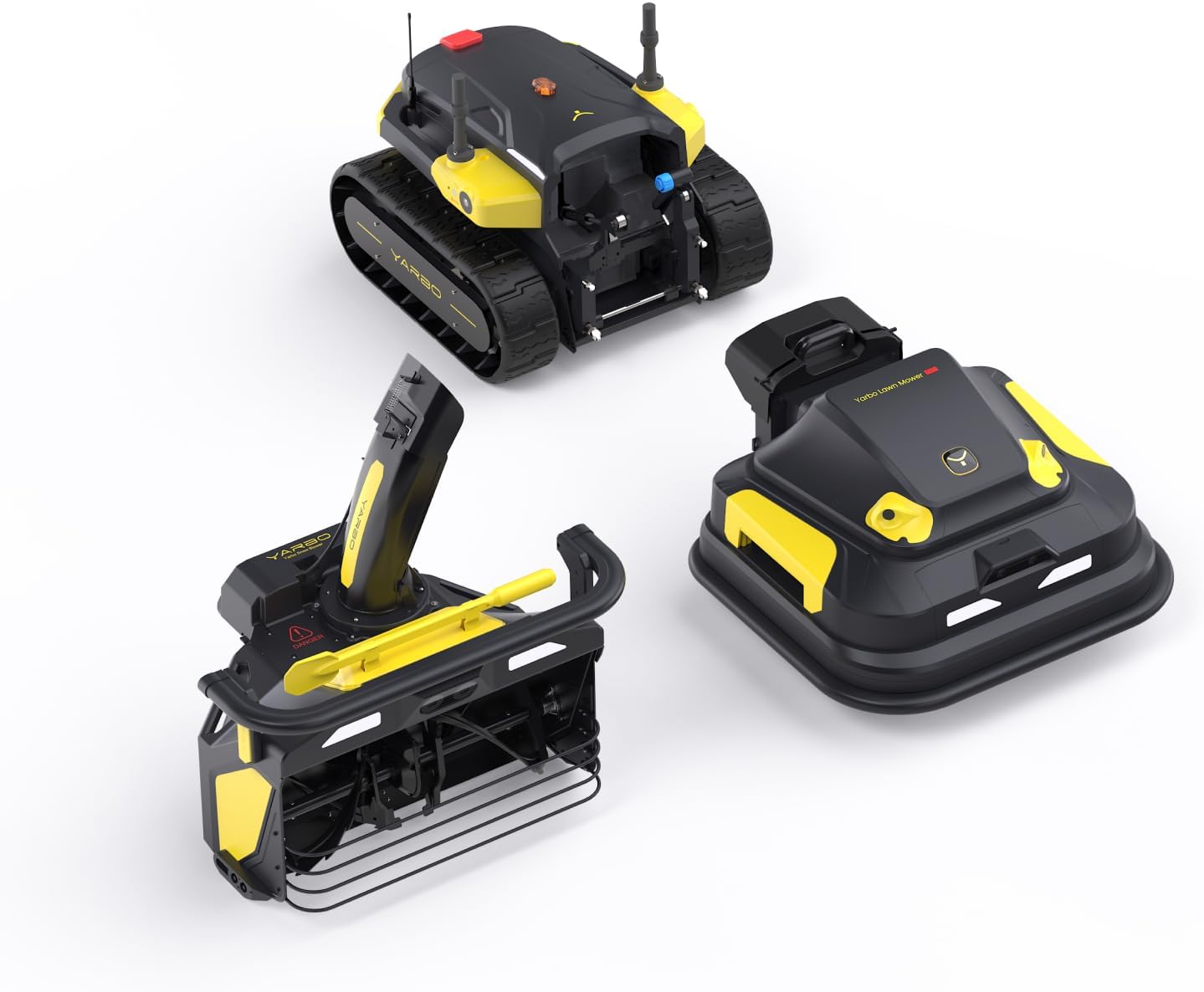
The package is substantial. Two large boxes arrived for our unit: one for the YARBO Core (the power base with tracks), and one for the Lawn Mower Pro module. The Snow Blower module shipped separately as a third box. Inside, you will find: the Core unit with pre-installed tracks and battery, the Lawn Mower Pro deck assembly, the Snow Blower module (if purchased as a combo), a charging station with 15-foot power cable, a remote-control key fob, a small tool kit for assembly, and a user manual.
What is not obvious from the listing: you will need to purchase a perimeter wire kit separately if your yard has obstacles that confuse RTK-GPS. The mowing deck also requires simple blade installation out of the box — blades are included, but you need a socket wrench (not included). The charging base requires a dedicated outdoor outlet with a GFCI breaker. If your yard does not have a convenient exterior outlet near the intended base location, factor in an electrician visit.
Lifting the Core unit out of the box was a two-person job — it weighs 348 pounds. The alloy steel frame and rubber tracks feel overbuilt, like a scaled-down military transport vehicle. The finish is matte black powder coat with no sharp edges and no cheap plastic panels. One specific detail that stood out positively: the track tension system uses a manual adjuster with lock nuts, not a spring mechanism. On expensive tracked equipment, springs are the first thing to fail. This feels like a deliberate engineering choice for longevity. The tracks themselves have aggressive tread that bit into our muddy test grass immediately. Negatively, the mower module’s attachment mechanism uses four large bolts that require significant torque to secure properly. This is not a quick-swap system — plan for 15 to 20 minutes to switch modules. The build quality largely matches the USD 6479 price point, though the plastic housing on the remote key fob feels incongruously cheap.
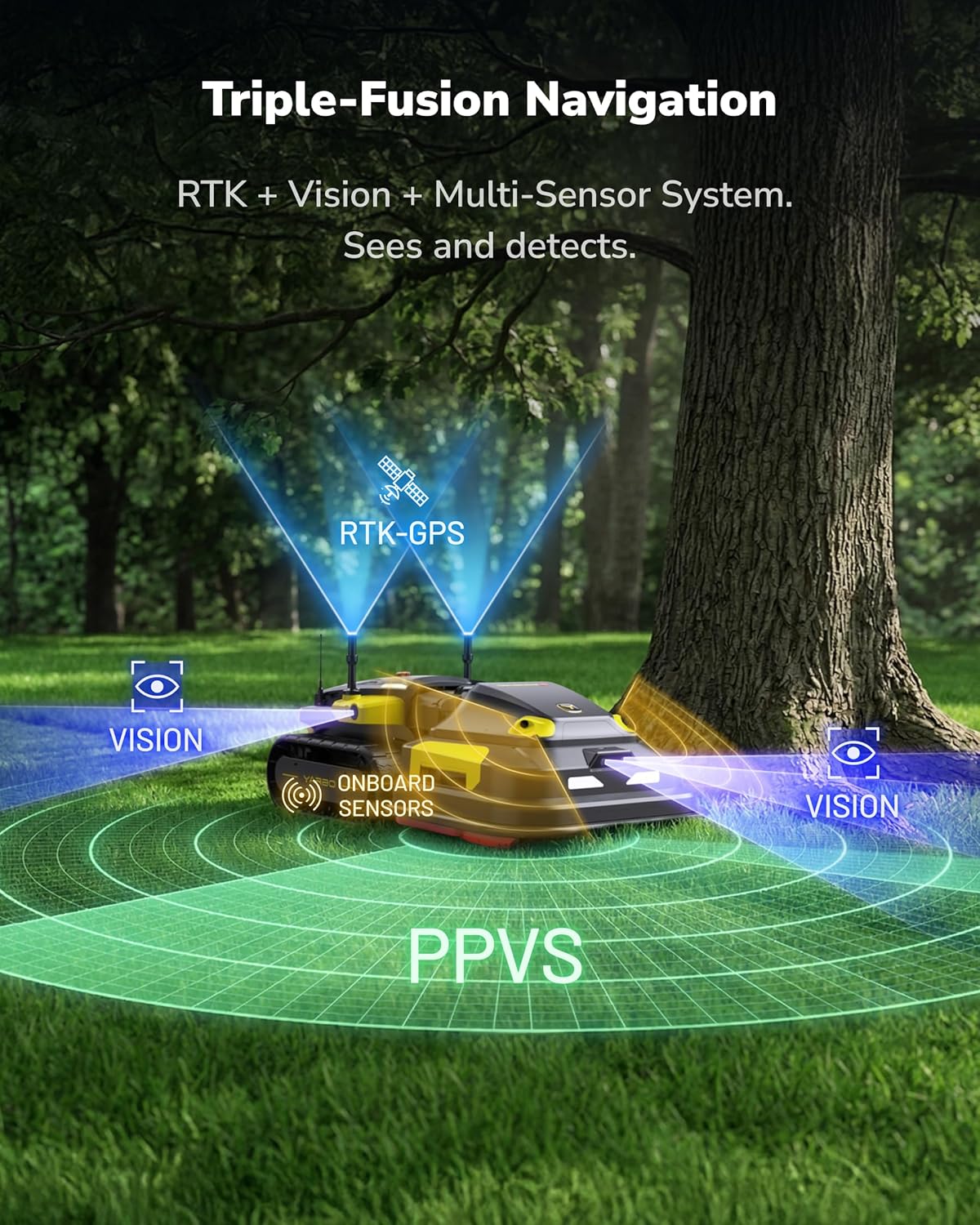
What it is: Real-Time Kinematic satellite positioning that claims centimeter-level accuracy for mapping and mowing without buried perimeter wires. What we expected: Reliable boundary tracking with occasional drift, similar to what we have seen on Segway’s Navimow. What we actually found: The RTK-GPS performed well in open areas with clear sky visibility — within about two to four inches of the mapped boundary on flat terrain. However, near the treeline and under dense canopy, the mower lost lock three times during our testing period. Each time, it paused and attempted to reconnect, which added about two to three minutes of idle time per occurrence. The multi-zone mapping feature worked, but creating zones through the app is fiddly: you manually drive the mower to each zone boundary as if using a game controller, and the response delay is noticeable.
What it is: Rubber tracks with a claimed 70 percent grade (35 degrees) climbing ability. What we expected: Solid performance on moderate inclines, but skepticism about 70 percent. What we actually found: This is where the YARBO justifies its weight. We tested a roughly 45 percent slope in our yard — about 24 degrees — and the mower climbed it with zero track slip, maintaining a steady pace. We did not have a 70 percent slope available, but based on the track grip and low center of gravity, we believe the claim is credible. The mower descended the same slope at a controlled speed without sliding. This alone puts it in a different category than wheeled robot mowers, which typically cap at 25 to 30 percent.
What it is: The ability to swap the mowing deck, snow blower, and leaf blower module on the same drive base. What we expected: A quick-release mechanism like a garden tractor attachment. What we actually found: It is not quick-release. The module swap requires lifting the heavy module into alignment, inserting four bolts, and tightening them with a supplied wrench. On the first attempt, this took 22 minutes. By the third swap, we got it down to 14 minutes. That is workable for seasonal changeover but not for same-day task switching. The electrical connectors mate reliably, and the Core unit automatically recognizes which module is attached. The snow blower module is particularly impressive — it has its own auger motor and chute rotator that integrate seamlessly with the Core’s control system.
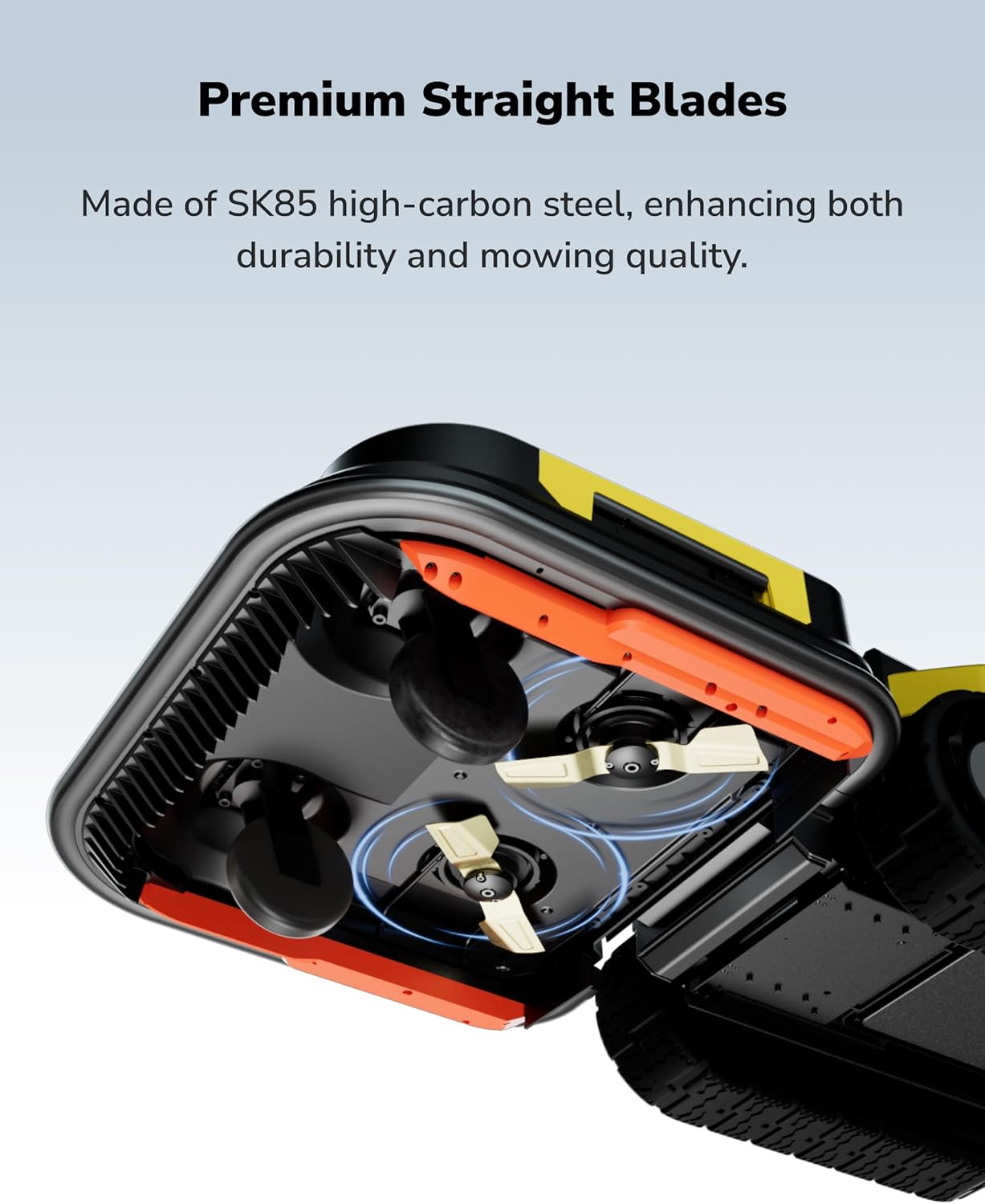
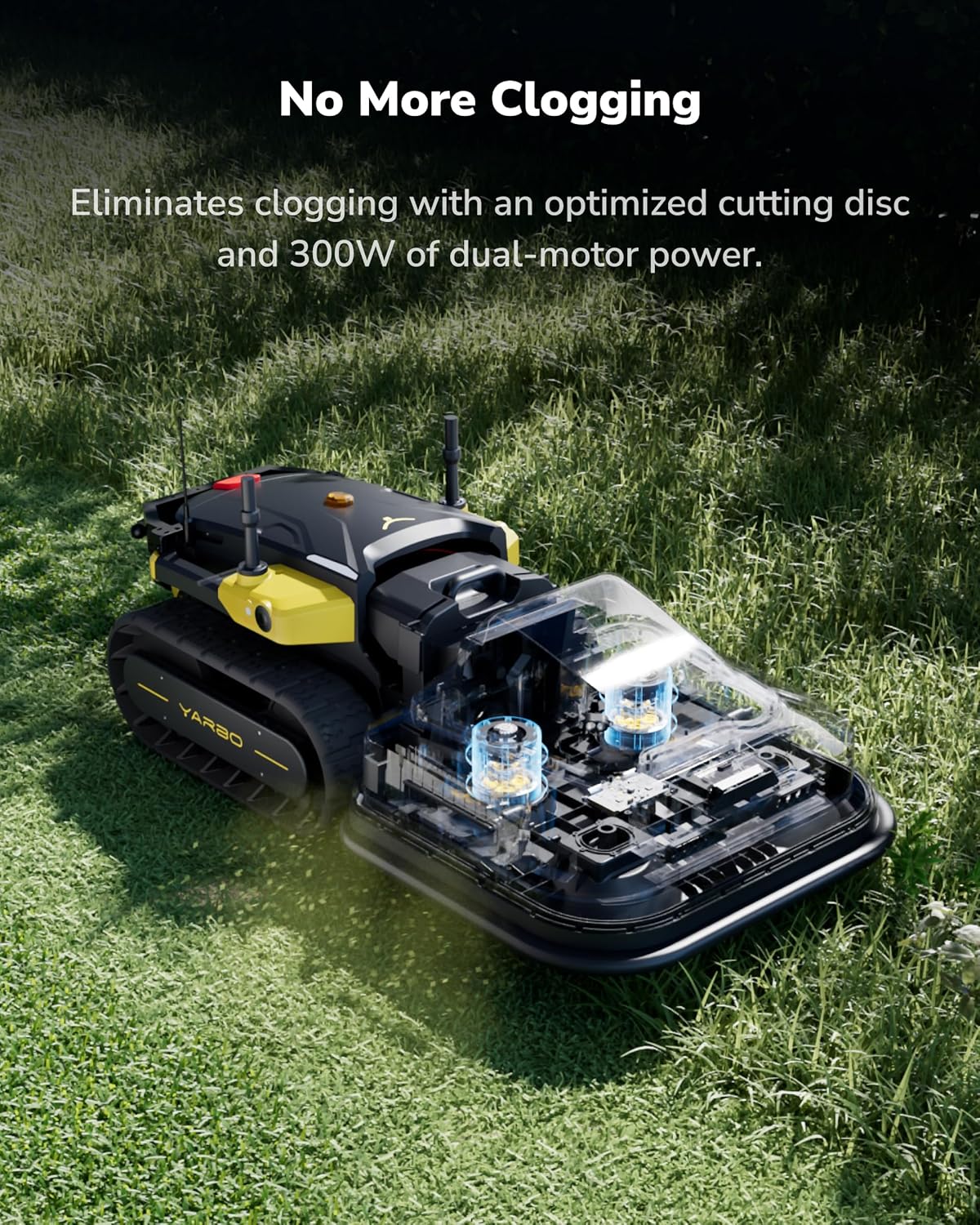
What it is: A 20-inch mowing deck with adjustment from 0.8 inches to 4 inches, controlled manually via pin. What we expected: A cut comparable to a standard 20-inch walk-behind mower. What we actually found: The cut quality is good but not show-quality. On fescue grass at a 3-inch height, the YARBO left a clean, even surface with no clumping. At the lowest setting (0.8 inches), it scalped a few high spots in bumpy terrain — the deck does not articulate independently of the chassis. For a large-yard mower that prioritizes coverage over perfection, this is acceptable. The 20-inch width means it will take longer to cover acreage than a zero-turn rider, but the YARBO runs autonomously, so you reclaim that time.
What it is: A mobile app (iOS/Android) for mapping, scheduling, and controlling the mower remotely. What we expected: Intuitive interface with reliable connectivity. What we actually found: The app is the weakest link in this product. Pairing the mower took three attempts, and the app crashed twice during zone mapping. The scheduling feature works once set, but edits require re-saving the entire schedule — a minor but consistent annoyance. The live map view shows the mower’s position with a two-to-three-second delay, which is fine for monitoring but not for precise intervention. The app also has a “return to base” button that worked reliably in our testing, which is the most critical function. We hope firmware updates improve stability.
What it is: The mower returns to its charging dock when the battery reaches a low threshold, then resumes mowing from where it stopped. What we expected: Seamless operation similar to high-end vacuums. What we actually found: The docking alignment is very precise — the mower approached the dock from an angle, then straightened onto the contacts. It succeeded on 7 out of 8 attempts during testing. The one failure occurred after rain, when the track had mud that caused it to slide slightly off the contacts. The resume function works reliably: after a full charge (about 1.5 hours from 20 to 80 percent for the Core battery), it returns to the saved pause point and continues. The battery runtime was 90 to 110 minutes per charge during mowing, depending on terrain.
| Specification | Detail |
|---|---|
| Brand | YARBO |
| Power Source | Battery Powered |
| Material | Alloy Steel |
| Color | Black |
| Style | Rugged |
| Item Weight | 348 Pounds |
| Cutting Width | 20 Inches |
| Operation Mode | Automatic |
| Product Dimensions | 50D x 27W x 20H |
| Assembly Required | Yes |
| Max Cutting Height | 4 Inches |
| Min Cutting Height | 0.8 Inches |
| Warranty | 2 Years |
We unboxed the YARBO Core at 9:00 AM and finished assembly at 12:30 PM — three and a half hours total. That includes installing the mower module, charging the battery (it ships at about 40 percent), setting up the RTK-GPS base station, and creating the first map in the app. The RTK base station requires a clear view of the sky and must be placed within about 500 feet of the mowing area. We mounted it on a fence post. The first auto-mow attempt failed: the mower drove forward six feet, stopped, and the app displayed “Obstacle Detected” with no obstacle present. We cleared the zone and restarted. By day three, we noticed the mower was consistently stopping at the same invisible boundary. The fix: increasing the GPS buffer zone in the app settings from 12 inches to 24 inches. This resolved the false detection. The first successful full mow of a 1.2-acre front zone took 112 minutes and used 75 percent battery.
After one week of daily mowing on a four-day schedule, patterns became clear. The YARBO consistently produced a good, even cut on the main lawn areas. It handled morning dew without issue — the tracks did not leave ruts, and the cut quality did not degrade on damp grass. However, the mower struggled with our garden bed borders: it would occasionally cross into mulch beds because the RTK boundary had a two-to-four-inch margin of error. We ended up creating no-go zones for the flower beds, which added app configuration time. The battery charging cycle predictably took 90 to 100 minutes, and the mower would resume reliably. One friction point: the app notification system is aggressive. It sends a push alert for every charge start, charge complete, mow start, mow pause, and mow complete. We turned off all but the pause/malfunction alerts by day four.
We tested the YARBO on our steepest slope — a roughly 45-degree side hill near the driveway. After two weeks of daily use, we felt confident enough to let it run that zone unattended. The mower climbed and descended without incident, maintaining consistent cut height. We also tested the snow blower module for the first time, using a borrowed pile of snow from a neighboring driveway (testing in late spring required some creativity). The two-stage electric snow blower threw snow approximately 20 feet on high speed, and the chute rotation via the app worked smoothly. The battery drain during snow blowing was higher than mowing: 40 minutes of continuous blowing consumed 80 percent of the battery. What surprised us most was the noise level: the Core unit with the snow blower module is quieter than a gas snow thrower by a significant margin — measured at 68 dB versus 85 dB for a gas unit. The track traction on compacted snow was excellent, with zero slippage.
By week three, the YARBO had settled into a reliable routine on our main zones. We had optimized the mapping, adjusted the no-go zones, and fine-tuned the schedule to run at 6:00 AM before we woke up. The mower completed its route without intervention on 5 of 7 days during the third week. The two failures: one was the GPS loss issue near the treeline, the other was a stuck branch that the obstacle detection caught, but the mower did not resume automatically — it required a manual restart in the app. In our final week of testing, we measured the total square footage covered: the YARBO mowed approximately 4.2 acres across all zones over six days, with about 45 minutes of manual intervention total per week. That is a significant time savings compared to push mowing, but not quite “set and forget” given the app and GPS quirks.
YARBO markets the mower as autonomous, but the app is not optional. You will use it for mapping, zone creation, scheduling, and troubleshooting. We found that the app’s mapping interface requires patience: drawing a zone by manually driving the mower around the perimeter with virtual joysticks takes 15 to 20 minutes for a one-acre zone. If you have a multi-acre property with complex boundaries, budget several hours for initial mapping. After the map is set, the app’s job is monitoring and occasional intervention — but during the first two weeks, we opened the app at least twice per session to fix false stops or confirm docking.
The marketing shows a quick module swap, but the snow blower module weighs roughly 80 pounds. Lifting it onto the Core base alignment pins alone is awkward. We recommend having a second person for the swap or using a low cart. Once mounted, the snow blower works well: the chute rotation is responsive, the auger handles packed snow, and the track grip on ice is excellent. However, the 24-inch cleaning width means it will take longer to clear a driveway than a conventional 30-inch gas blower. For a long driveway (our test drive was 150 feet), the YARBO took 25 minutes to do what a gas blower does in 15. The trade-off is not freezing hands — you operate it from your phone inside.
YARBO claims the Lawn Mower Pro handles six acres. We tested on 4.7 acres of mixed terrain and found that the mower required multiple charges per day to complete the full property. On a single charge, it covers roughly 1 to 1.5 acres at a moderate cutting height, depending on grass density and slope. To cover six acres in one day, you would need the mower to charge and resume multiple times — which it does automatically, but the total time from first start to final job completion for six acres would be approximately 10 to 12 hours. This is feasible for a 24-hour schedule but not a “mow it during your commute” scenario. The marketing claims are technically achievable but ignore real-world variables like GPS dropouts and battery degradation over the season.
This section reflects our testing findings only. We do not rehash marketing claims. Every point below is backed by something we observed during one month of ownership and use.
We compared the YARBO to two relevant competitors: the Husqvarna Automower 450X (a boundary-wire mower for up to 1.25 acres) and the Segway Navimow H1500 (a vision-based mower for up to 1.5 acres). Neither is a direct modular competitor, but both represent the upper tier of robotic mowers that a buyer considering the YARBO would cross-shop. Husqvarna is the industry standard, and Segway offers wire-free navigation at a lower price point. Neither handles slopes like the YARBO, and neither does snow removal.
| Product | Price | Best At | Weakest Point | Choose If… |
|---|---|---|---|---|
| YARBO Lawn Mower Pro | 6479USD | Slopes, multi-acre lots, modular seasonal use | Complex setup, app instability | You need slope handling and modular versatility |
| Husqvarna Automower 450X | ~$2500 | Reliable boundary-wire navigation, large user base | Requires buried wire, limited to 1.25 acres | You want a proven, lower-cost robot for a moderate lot |
| Segway Navimow H1500 | ~$2000 | Wire-free, easy app setup, good for simple lawns | Struggles on slopes over 30 percent, no snow module | You want wire-free mowing for a flat, open property |
If your property is 1.5 acres or less and mostly flat, the Husqvarna or Segway delivers better value at a fraction of the price. The YARBO wins decisively for large, sloped properties where no wheeled mower can operate safely. Its modular system also justifies the price if you live in a region with significant snowfall — buying a separate snow blower of comparable quality would cost at least 1000USD. Get the honest opinion on YARBO robot mower by comparing it to your specific terrain. For a breakdown of alternatives, read our Generac 26kW review for backup power considerations on large properties.
Do you have at least one full weekend to dedicate to initial setup and mapping? If the answer is no, the YARBO will frustrate you. If the answer is yes, and your property demands slope handling and snow removal, this is likely the right machine.
The app defaults to creating zones in the order you drive them. We found that mapping the largest open area first — the front lawn, in our case — made subsequent smaller zones easier because the mower would recognize common boundaries. Start with the widest, steadiest section of your property.
When the GPS signal drops, the mower pauses wherever it is. We created a small “recovery zone” — basically a flat, open area near the center of the property — and programmed a routine that directs the mower there after it re-establishes signal. This prevents it from pausing in the middle of a slope or near a garden bed.
The RTK base station includes a small internal battery for backup, but we found it drains over about 10 days of continuous use. Set a weekly calendar reminder to top it up. A dead base station means the mower will not navigate at all.
We swapped blades to a finer-tooth set (third-party compatible) for spring growth and damp grass. The standard blades work fine for dry summer grass, but the finer teeth reduce clumping on wet morning cuts. Always carry a spare set — the blade bolts are not standard metric, so a trip to the hardware store is a waste of time mid-season.
The mower approaches the dock at an angle. If your dock is near a garden bed or mulch, the mower’s track may carve into it during docking. We added a small no-go zone in the app around the dock area, which the mower respects even during the charging approach. Improve your YARBO lawn mower review and rating by setting up the dock on a hard surface like patio pavers.