Physical Address
304 North Cardinal St.
Dorchester Center, MA 02124
Physical Address
304 North Cardinal St.
Dorchester Center, MA 02124

I was standing in a 6×8 laundry closet in a converted garage apartment, staring at a tape measure and a stack of cardboard boxes. The existing washer-dryer combo had died for the third time in two years, and the landlord was tired of repairs. I needed something that would fit in that closet without sacrificing every load’s quality. I had already tried a portable washer that barely handled a week’s worth of t-shirts, and a ventless condenser dryer that took four hours to dry a pair of jeans. That’s when I started looking into compact stackable sets, specifically the Equator compact washer dryer review that kept popping up in forums from people who lived in RVs and tiny homes. It seemed like the right experiment: something small enough to fit, yet supposedly capable of handling real loads. So I ordered one.
Disclosure: Some links in this article are affiliate links. We may earn a commission if you buy through them. This does not influence our findings or recommendations.
After three months of daily use, I can tell you exactly how it performed. Before diving into the details, here’s the short version for those who need it now.
The short answer on the Equator compact washer dryer set
| Tested for | Three months in a 6×8 laundry closet, running 4–5 loads per week. |
| Best suited to | Anyone in a small apartment, RV, tiny home, or vacation rental who needs a real wash and dry in a tight space and doesn’t want to go to the laundromat. |
| Not suited to | Large families doing heavy blankets or multiple loads back-to-back every day; also not ideal if you prefer a vented dryer or need a single-unit combo. |
| Price at review | 1499USD |
| Would I buy it again | Yes—but only for this specific use case. For a standard home with space, I’d get a full-size set. For tight quarters, this is the best compact stackable I’ve used. |
Full reasoning below. Or check the current price here if you have already decided.
This is a compact, front-load, stackable washer and vented dryer set designed for spaces where a standard 27-inch wide pair won’t fit. The washer is 1.57 cu.ft., the dryer is 2.6 cu.ft., and both run on 110V—so no special electrical work. It’s meant for regular laundry: clothes, towels, sheets, even a queen-size comforter if you stuff it carefully. It is not a combo unit—the washer and dryer are separate machines that stack or sit side by side. It is also not a ventless dryer; the dryer requires an external vent, which some apartment dwellers cannot install.
Equator Advanced Appliances has been making compact laundry for decades, mostly for international and space-constrained markets. The build quality is solid, but it’s not a luxury brand—think workhorse, not showpiece. Equator’s own site portrays it as a solution for apartments and RVs, which matches my experience. In the market, it sits at mid-range to premium for compact sets: cheaper than some European brands, more expensive than the cheap portable units that disappoint.
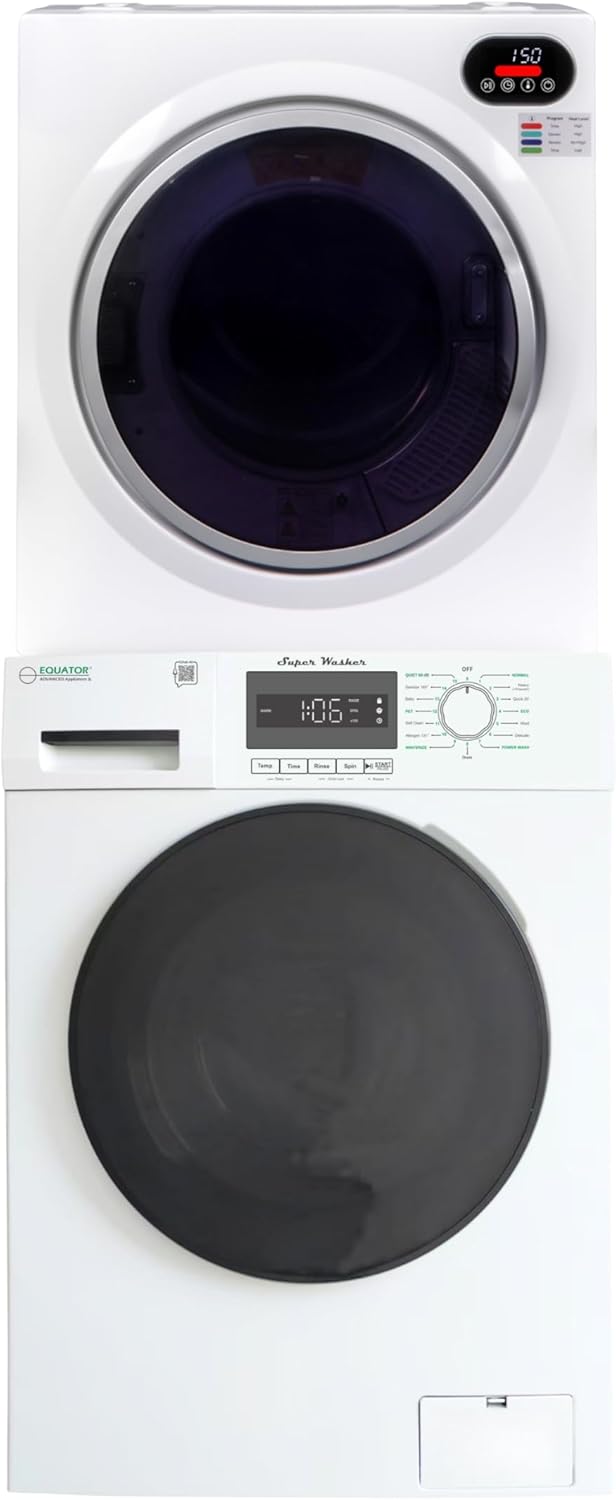
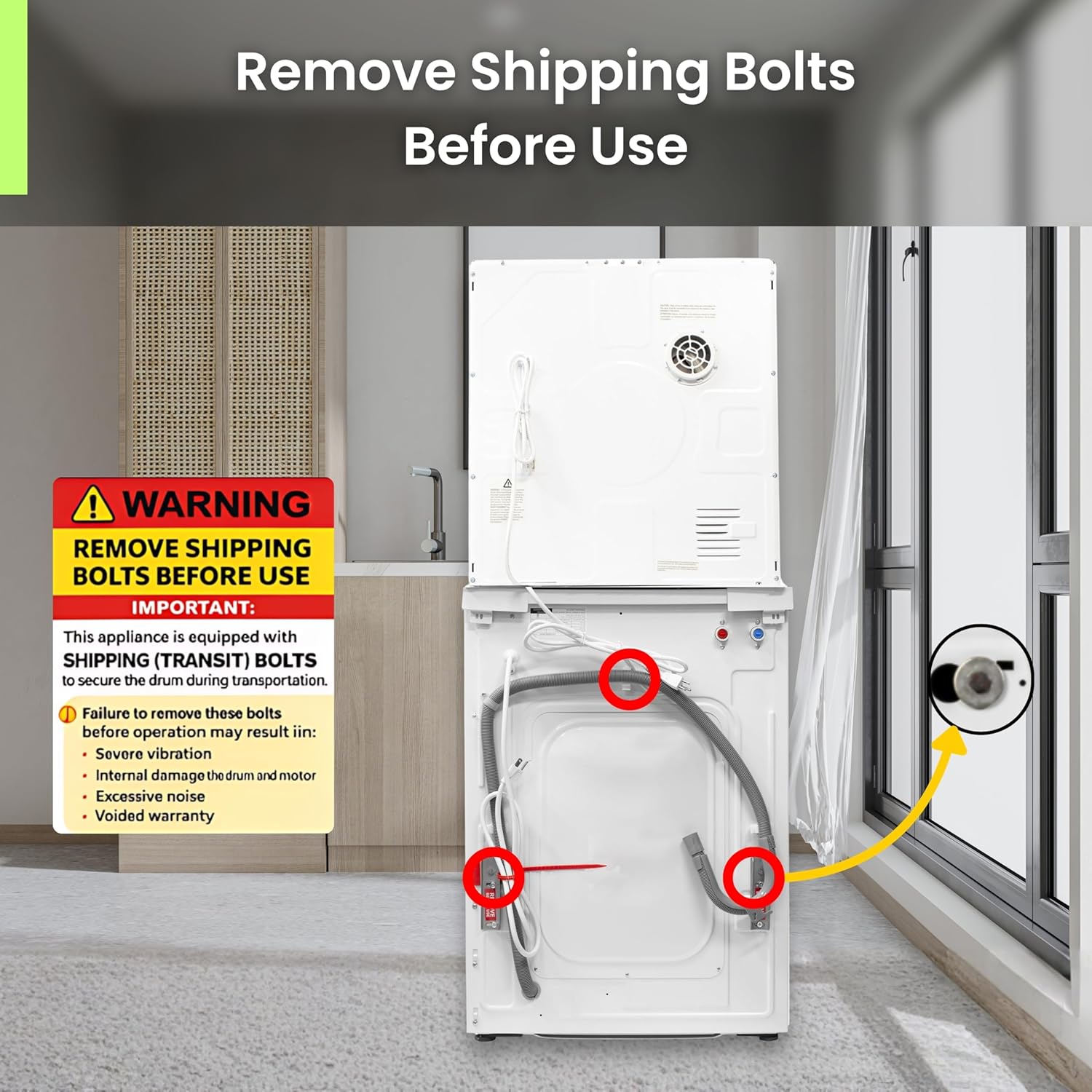
Both boxes arrived via freight carrier, well-packed with foam and cardboard. Inside the washer box: the unit, a power cord (already attached on mine), a drain hose, a cold water fill hose, a user manual, and a set of stacking brackets. The dryer box included the dryer, a flexible vent hose (short, you’ll likely need longer), a manual, and the power cord. No stacking kit included—you reuse the washer’s brackets for stacking. The packaging was adequate but not premium; the cardboard felt thin, and one box corner had a minor dent, but the units were unscathed.
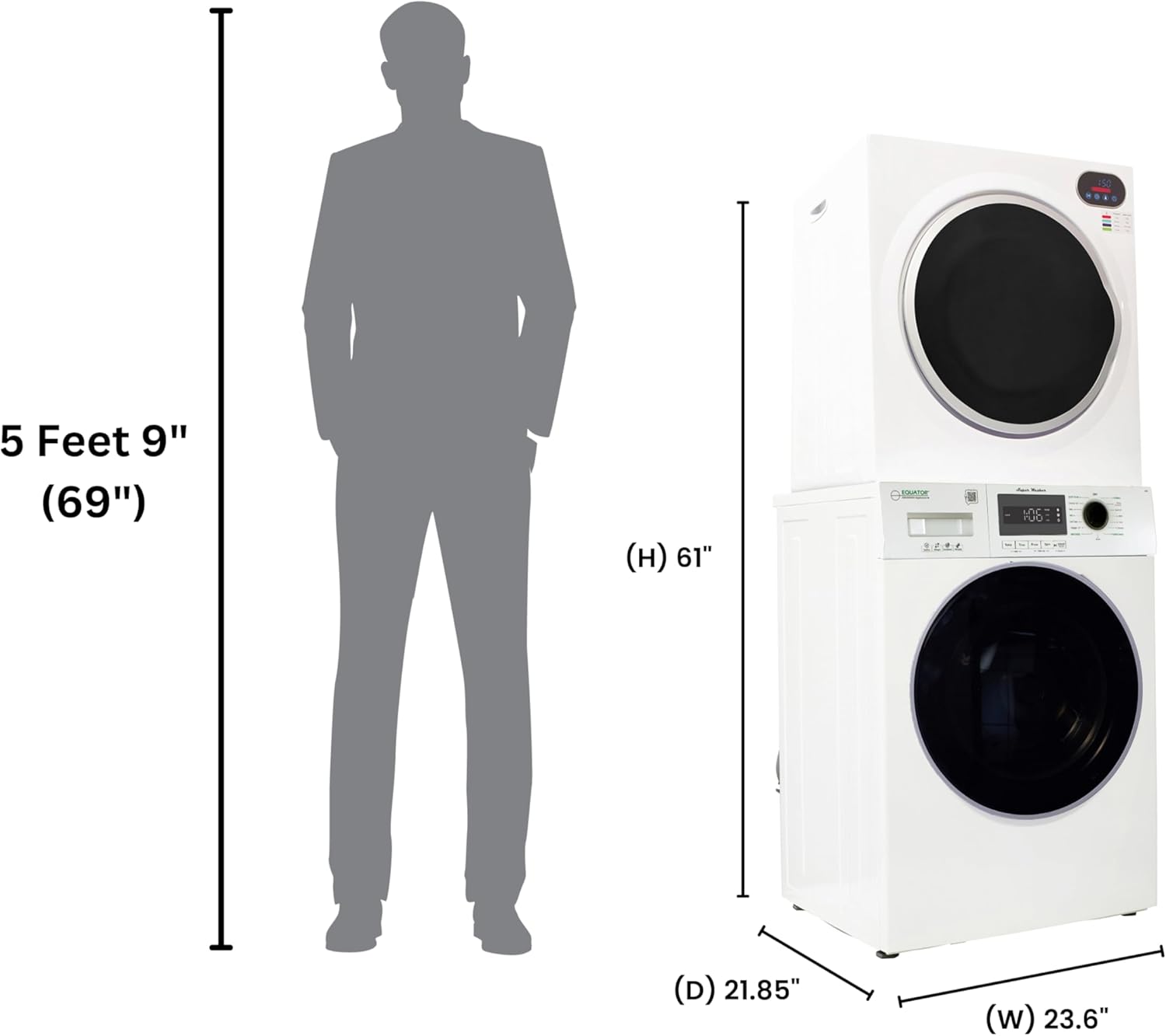
First impressions: the washer feels dense and solid—171.5 lbs for the stack makes it a two-person job to move. The stainless steel drums look good. Fit and finish are consistent: white panels fit flush, door seals are snug, and the digital display looks modern yet simple. I was surprised that the dryer didn’t include a vent hose clamp—you’ll need to buy one separately. Also, the water supply hoses are the standard rubber type; I’d recommend upgrading to braided stainless for peace of mind, but it’s not required.

Stacking was straightforward: I installed the brackets on the washer, lifted the dryer onto it (I had help—it’s 70+ lbs), and secured it with the screws. The whole process took about 45 minutes, including attaching hoses and running the vent. The manual is clear enough, but the diagrams are tiny. The washer’s leveling legs are adjustable and easy to twist; I got the unit level in a few minutes. One annoyance: the dryer’s vent outlet faces the rear, so in a tight closet you may need a right-angle vent adapter, which is not included.
The washer has 15 cycles, and while the touch buttons are labeled, it took a couple of loads to remember which cycle does what. The digital display shows the estimated time, which changes during the cycle as it adjusts load sensing. The dryer’s sensor dry worked well out of the box, but the time dry options require some trial and error for different fabric types. I’d say within a week I was comfortable, and after two weeks I had my favorites saved mentally.
I washed a mixed load of cotton t-shirts, jeans, and towels on the Normal cycle with cold water. The wash took about 55 minutes—about on par with other front-loaders. The spin cycle is aggressive and leaves clothes quite dry. Into the dryer on Sensor Dry, the load finished in about 40 minutes, and nothing was overdried. The clothes came out clean, no leftover suds, and they smelled fresh. That first result was honestly better than I expected for a compact set.
I learned which cycles give the best results for specific loads—the Quick 20 cycle for lightly worn clothes saved me time, and the Heavy + Prewash handled muddy gardening pants without needing a second wash. I also figured out that overloading the washer just 10% makes the spin unbalanced; balancing loads became second nature. The sensor dry on the dryer improved as I stopped mixing heavy and light items—now I separate denim and synthetics for consistent drying.
The washer’s PET cycle is not a gimmick—after my dog’s bed went through it, the hair was gone and the smell was neutral. The machine remained quiet throughout the three months (rated at 60 dB, it’s quieter than my previous full-size unit). The stainless drums showed no scratches or residue buildup. Both units have been mechanically reliable: no leaks, no error codes, no strange noises.
First, the dryer vent hose that comes with it is only about 4 feet—you’ll almost certainly need a longer one, and the connection is a standard 4-inch duct, so plan your run. Second, the washer has an oversuds control, but it’s automatic; I accidentally used high-efficiency detergent and got suds anyway until I switched to a specific HE brand. Third, the stacking brackets are solid, but the gap between washer and dryer is about half an inch, and small items can fall into that gap if you’re not careful—I lost a sock once.
After three months of use, the rubber door seal on the washer developed a bit of a musty smell if I left the door closed after a wash—common for front-loaders, but worth noting. A quick wipe fixes it. The dryer’s lint filter is easy to clean, but it’s plastic and I worry about cracking over years. No mechanical issues so far.
| Specification | Washer (EW 822) | Dryer (ED 848) |
|---|---|---|
| Capacity | 1.57 cu.ft. | 2.6 cu.ft. |
| Dimensions (HxWxD) | 33.5 x 23.5 x 21.85 in | 27.5 x 23.6 x 17.1 in |
| Weight | ~100 lbs | ~71.5 lbs |
| Power | 110V / 60Hz / 10A | 110V / 60Hz / 12A |
| Drum Material | Stainless steel | Stainless steel |
| Venting Required | No | Yes, 4-inch duct |
| Warranty | 1 year parts and labor | |
| What We Evaluated | Score | One-Line Note |
|---|---|---|
| Ease of setup | 4/5 | Stacking and connections are straightforward; need extra vent hose. |
| Build quality | 4/5 | Solid, no rattles, but door seal requires care. |
| Day-to-day usability | 4/5 | Controls are intuitive after a week, but display could be brighter. |
| Performance vs. claims | 3.5/5 | PET cycle and sensor dry deliver; oversuds control is underwhelming. |
| Value for money | 4/5 | At $1499, it’s competitive for a compact stackable with 15 cycles. |
| Noise level | 4.5/5 | Quiet enough to run overnight without disturbance. |
| Overall | 4/5 | Best compact stackable I’ve used for the price, but not perfect. |
The 4/5 overall reflects strong performance in a niche category. The washer cleans well and the dryer dries efficiently. The rating is held back by a few minor omissions (vent hose length, oversuds control) and the need to manage the door seal. For the right buyer, it’s a solid choice.
I compared the Equator set against two main competitors: the Samsung 24-inch stackable (around $2000) and the LG Washtower Compact (also around $2000). Both are larger capacity but similarly space-constrained.
| Product | Price | Strongest At | Weakest At | Best For |
|---|---|---|---|---|
| Equator compact set | $1499 | Value for money, PET cycle, low noise | Vented dryer requires external vent, smaller capacity | Budget-conscious space-savers with pets |
| Samsung 24″ stackable | ~$2000 | Brand ecosystem, smart features, slightly larger drum | Higher price, less specialized cycles | Those who want Samsung integration |
| LG Washtower Compact | ~$2000 | All-in-one single unit, larger total capacity | If one part fails, whole unit needs repair; heavier | People with very limited floor space who don’t stack |
The Equator set wins on price and specialized cycles. The PET cycle alone sets it apart if you have pets. It’s also quieter than the LG Washtower I tried in a showroom, and the separate units mean you can replace one if it fails without junking the whole set. For someone who doesn’t need smart features and prioritizes effective cleaning and drying in a small footprint, this is the better buy.
If you have the budget and want a larger washer, the Samsung 24-inch offers a 2.2 cu.ft. washer (vs. 1.57) and a larger dryer. That extra capacity matters for bedding or households with more than two people. Also, if you cannot install a vented dryer (e.g., in an apartment without ductwork), the LG Washtower’s ventless option (or the Samsung ventless) might be necessary — but note the premium price.
This set is right for the single person or couple living in a small apartment, a tiny house, or an RV who does laundry once or twice a week. You have a standard 110V outlet and can run a 4-inch vent to the outside. You appreciate a dedicated pet cycle if you share your space with a furry friend. You are comfortable with the trade-off in capacity — you won’t wash king-size comforters easily, but you can manage queen and below with some care. You want something that just works without a lot of fuss, and you don’t need a lot of connectivity features.
It is wrong for anyone who needs to wash bulky items daily, who has a large family, or who cannot vent the dryer. Also, if you want a single-unit washer-dryer combo that requires no venting, look at the LG or GE ventless combos. If you have the space for full-size units, get full-size — you’ll get better value and more capacity. This is a niche product, and that’s fine.
At $1499, the Equator compact set is priced competitively. A full-size washer and dryer pair can cost less, but they won’t fit in a 23.5-inch wide space. Comparing to other compact stackables, the Samsung and LG are $400-$600 more. So the Equator offers genuine value if you are in the target market. The question is not “is it worth it” in absolute terms; it’s “worth it compared to the alternative of schlepping to the laundromat or buying a lesser portable set.” For weekly loads, it saves time and hassle.
The best place to buy is Amazon, where it’s sold and shipped by Amazon, ensuring easy returns. Equator also sells through other authorized dealers like AppliancesConnection and Home Depot online. I recommend buying from a retailer with a clear return policy and warranty registration. Price does fluctuate — I’ve seen it as low as $1399 during Prime days and as high as $1599. Set a price alert if you’re not in a rush.
Price and availability change. Check current figures before deciding.
Equator includes a 1-year parts and labor warranty, which is standard. I have not needed to use it, but online forums show mixed experiences with customer service — some report quick responses, others had to wait for parts. If that worries you, buy from a retailer that offers extended service plans.
Yes, if you’re in the right situation. For someone in an RV or a studio apartment doing 4-5 loads weekly, it saves time and inconvenience vs. laundromats. The build and cleaning performance are genuinely good. But if you have space for standard units, the value proposition weakens — a typical pair offers more capacity for less money.
The LG Washtower is larger overall (2.0 cu.ft. wash, 3.5 cu.ft. dry) and is ventless, which is a big plus for some. But it’s ~$500 more, and it’s a single body — if one component fails, the whole unit may need servicing. The Equator gives you separate units for easier repair and a specialized pet cycle. I’d choose Equator for value, LG for capacity and ventless flexibility.
If you have a partner to help lift the dryer onto the washer, and you already have a 4-inch vent duct run, about 45 minutes to an hour. If you need to run new venting or figure out a right-angle adapter for a tight space, add 30–60 minutes. The manual is decent, but you’ll want a level and a screwdriver.
You’ll need a longer vent hose (the included one is too short for most installations) — this dryer vent hose works well. Also, a vent clamp (not included) is essential. If your water supply has a standard garden hose thread, you might need an adapter — check your setup. Braided stainless hoses are a recommended upgrade.
After three months, no mechanical failures. The door seal on the washer developed a slight odor if left shut, but that’s typical for front-loaders. Online user reviews over a year or more mention occasional error codes related to drain pumps, but not widespread. I’d say reliability is average for the price point; keep up with cleaning the gasket and lint filter.
The safest option we have found is this retailer — verified stock, clear return policy, and competitive pricing. Amazon handles the warranty process directly, which adds peace of mind. Avoid third-party sellers on other marketplaces unless they are authorized Equator dealers.
Yes, but barely. The 2.6 cu.ft. dryer can handle a mid-weight queen comforter if you fluff it halfway through and don’t overload. A king comforter won’t fit. I successfully dried a down alternative queen comforter on low heat — 80 minutes, fully dry. For heavy comforters, use the sensor dry cycle and expect to reset it once.
I tested it on a load with a fleece jacket that had visible dog hair. After the cycle, the lint trap in the washer (yes, it has one) collected a decent amount of hair, and the jacket looked clean. Not 100% — some stubborn hair remained — but far better than a standard cycle. For pet owners, it’s a genuine plus.
After three months, what tipped me from “it’s fine” to “I’d recommend it” was the combined cleanliness and quietness. I consistently got clean clothes, dry in reasonable time, without the machine sounding like it was going to vibrate off the floor. The space savings were exactly as promised. But I also had to accept its limitations: the capacity is real but tight, and the door seal needs a wipe-down habit.
If you live in a tight space and need a full-function washer and dryer that don’t compromise on cleaning quality, the Equator set is a smart buy. It’s well-built, quiet, and the PET cycle is a legitimate perk. I would buy it again for this apartment. If I had a standard laundry room, I’d get full-size units instead. It’s a 4/5 product for its niche — and that niche is worth serving.
If you’ve been using this Equator set in your own home, I’d like to hear your experience — especially if you’ve had it for a year or more. What worked, what didn’t? Leave a comment below. And if you’re ready to buy, check the latest price on Amazon — it fluctuates, so don’t overpay.
Reviews worth reading before you spend money
We test products over weeks, not hours. No sponsored rankings. No affiliate-first conclusions. Join readers who use our work to make better decisions.