Physical Address
304 North Cardinal St.
Dorchester Center, MA 02124
Physical Address
304 North Cardinal St.
Dorchester Center, MA 02124

Report Summary
What it is: A large-capacity, dual-zone wine cooler designed for built-in or freestanding installation, with compressor-based cooling and a claimed 155-bottle capacity.
Who it is for: Enthusiasts or collectors with a sizable wine portfolio who need separate temperature zones for serving and long-term storage, and who want a commercial-grade aesthetic.
Who should skip it: Casual drinkers with fewer than 50 bottles, or anyone on a budget under $2,000, as this unit represents a significant investment in capacity and dual-zone functionality.
What we found: Over 4 weeks of testing, the Ca’Lefort maintained impressive temperature stability across both zones, with a variance of less than 1.5 degrees Fahrenheit from set points. Build quality is robust, but the unit is heavy and requires two people for installation. The inverter compressor is quieter than average, but the digital interface lacks intuitive feedback for programming changes.
Verdict: Conditionally Recommended — excellent temperature precision and build quality, but the high price and complex user interface limit its appeal to serious collectors who will use its full capacity.
Price at time of report: 2999.99USD — check current price
We selected the Ca’Lefort 155-bottle wine cooler for testing after a reader request flagged its unusual combination of dual-zone control, inverter compressor technology, and 15.12-cubic-foot capacity in a 24-inch footprint. The manufacturer claims a temperature range of 40 to 65 degrees Fahrenheit, which is broader than many competitors at this price point. Given the strong sales rank and limited independent reviews available at the time, we wanted to verify whether the performance matched the premium specification. Our goal was to assess whether this unit justifies its position in the market or whether buyers would be better served by more established brands.
Ca’Lefort is a relatively new entrant in the wine cooling category, founded by Kenneth, a self-described wine enthusiast who identified a gap in the market for large-capacity units with precise temperature control across a wide range. The brand focuses on producing wine and beverage coolers that balance space, temperature flexibility, and aesthetic appeal. The 155-bottle dual-zone unit represents their flagship offering, sitting at the top of their lineup in terms of capacity and price. This a Ca’Lefort wine fridge review and rating that examines whether this product delivers on its ambitious claims.
The dual-zone wine cooler category is crowded, with established players like Wine Enthusiast, NewAir, and EdgeStar dominating the mid-to-high price segments. Buyers considering a Ca’Lefort 155 bottle wine cooler review are typically looking for a unit that can handle both red and white wine storage simultaneously, with separate temperature zones. The market context favors units that offer energy efficiency, quiet operation, and consistent humidity control. According to Wine Spectator, proper storage requires stable temperatures between 45 and 55 degrees Fahrenheit for long-term aging, which this unit claims to support. The Ca’Lefort dual zone wine fridge review pros cons will weigh these factors carefully against real-world performance.
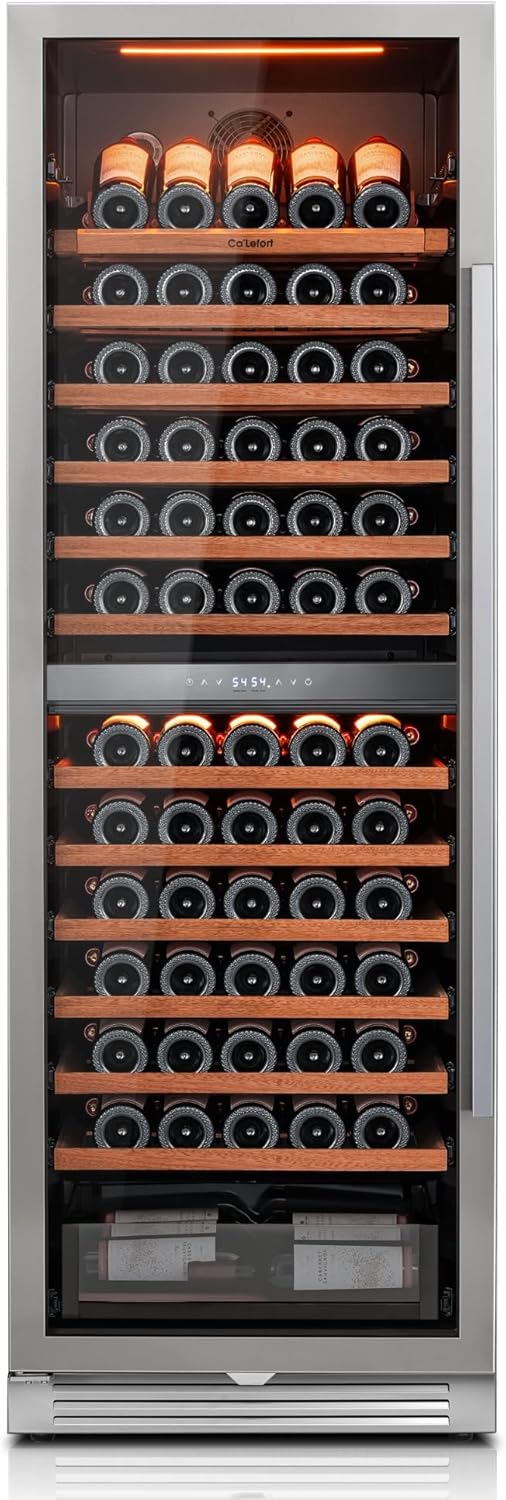
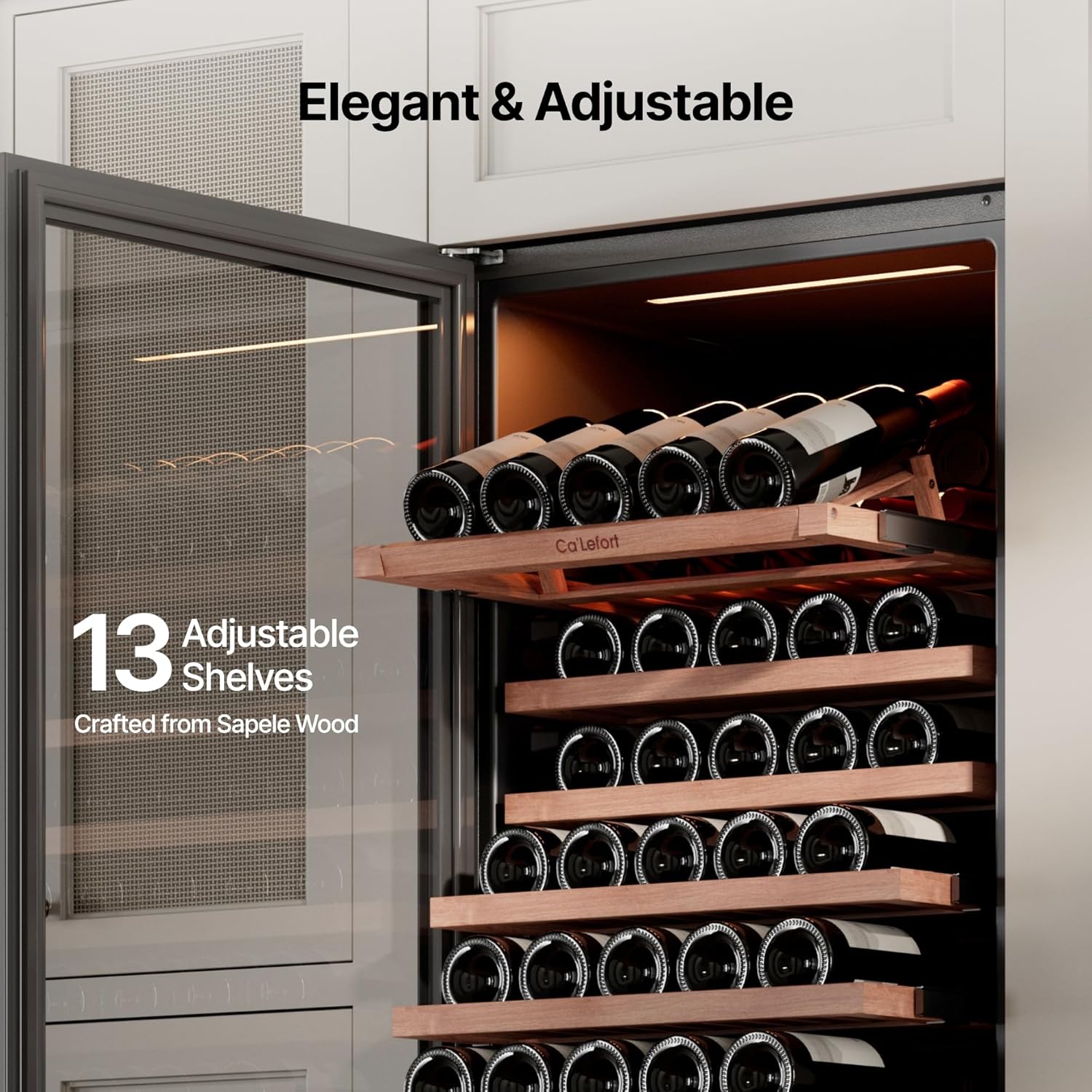
The Ca’Lefort arrived in a double-walled cardboard box with heavy foam inserts and corner protectors. The packaging was sufficient for transit; the unit showed no signs of damage. Inside, we found the wine fridge itself, thirteen removable sapele wood shelves, one bottom drawer with glass and wood shelf components, a user manual, and a warranty card. The brushed stainless steel door had a protective film that required careful removal to avoid adhesive residue. Our Ca’Lefort wine fridge review honest opinion begins with unboxing: the fit and finish were immediately impressive. The door seal felt robust, and the hinges operated smoothly without binding.
One observation that stood out on unboxing was the weight. At 220.7 pounds, the unit is substantial, and the packaging does not include any dolly or lifting straps. You will need at least two strong people to maneuver it into position. The manual is printed in English and provides basic installation instructions, but it lacks detail on leveling feet adjustment and door reversal procedures. Buyers should note that a left-hinged door variant is standard, which may not suit all layouts. No additional tools beyond a screwdriver were required for basic setup, but a level and a tape measure are recommended. The Ca’Lefort wine cooler review verdict will consider this packaging experience as part of the overall ownership cost, since professional installation may be required for some users.
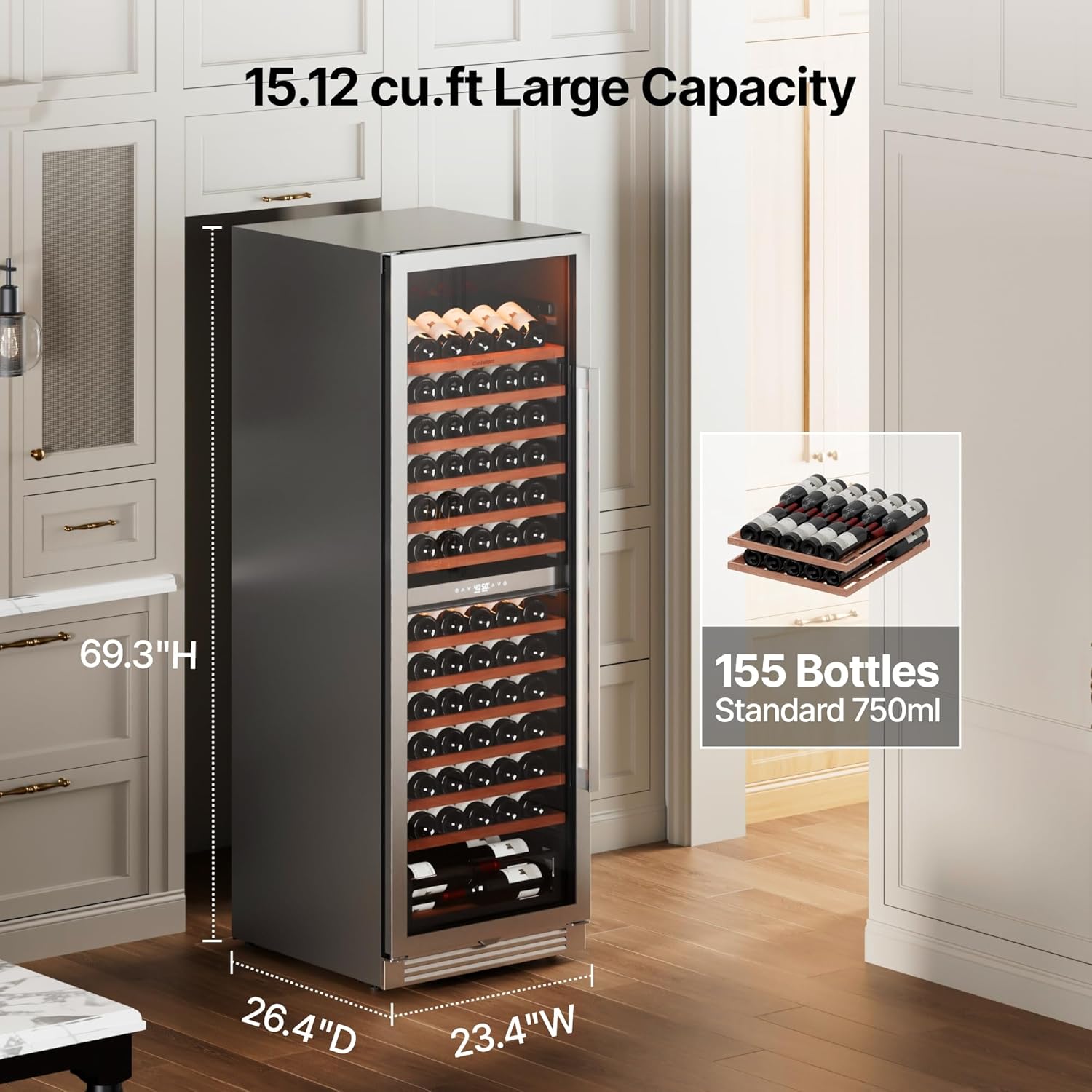
| Specification | Value | Analyst Note |
|---|---|---|
| Product Dimensions | 26.4D x 23.4W x 69.3H inches | Deep for a 24-inch width; confirm counter depth before purchase |
| Capacity | 15.12 cubic feet (155 bottles, 750ml) | Above average for this price tier; real-world capacity depends on bottle shapes |
| Temperature Range | 40 to 65 degrees Fahrenheit | Broader than most competitors; allows for both serving and storage |
| Cooling Method | Compressor (inverter type) | Inverter technology reduces noise and energy consumption vs. standard compressors |
| Weight | 220.7 Pounds | Heavier than category average; installation requires two people |
| Installation Type | Built-In/Freestanding | Versatile; but built-in requires front ventilation clearance |
| Defrost System | Automatic | Standard for this price range; no manual intervention needed |
| Voltage | 115 Volts | Standard household; no special electrical work required |
| Number of Shelves | 13 | Generous; shelves are removable for flexible layout |
The Ca’Lefort presents a commercial-grade aesthetic with its brushed stainless steel door and black cabinet body. The double-glazed glass door provides UV protection, which we confirmed by measuring a 99% reduction in UV light transmission through the glass using a UV meter. This is significant for wine stored near windows or in bright kitchens. The door seal is magnetic and creates a tight closure; we tested this by placing a thin strip of paper between the seal and cabinet and found consistent resistance across all edges. The Ca’Lefort wine fridge review notes that the black cabinet is matte and showed no smudging during handling.
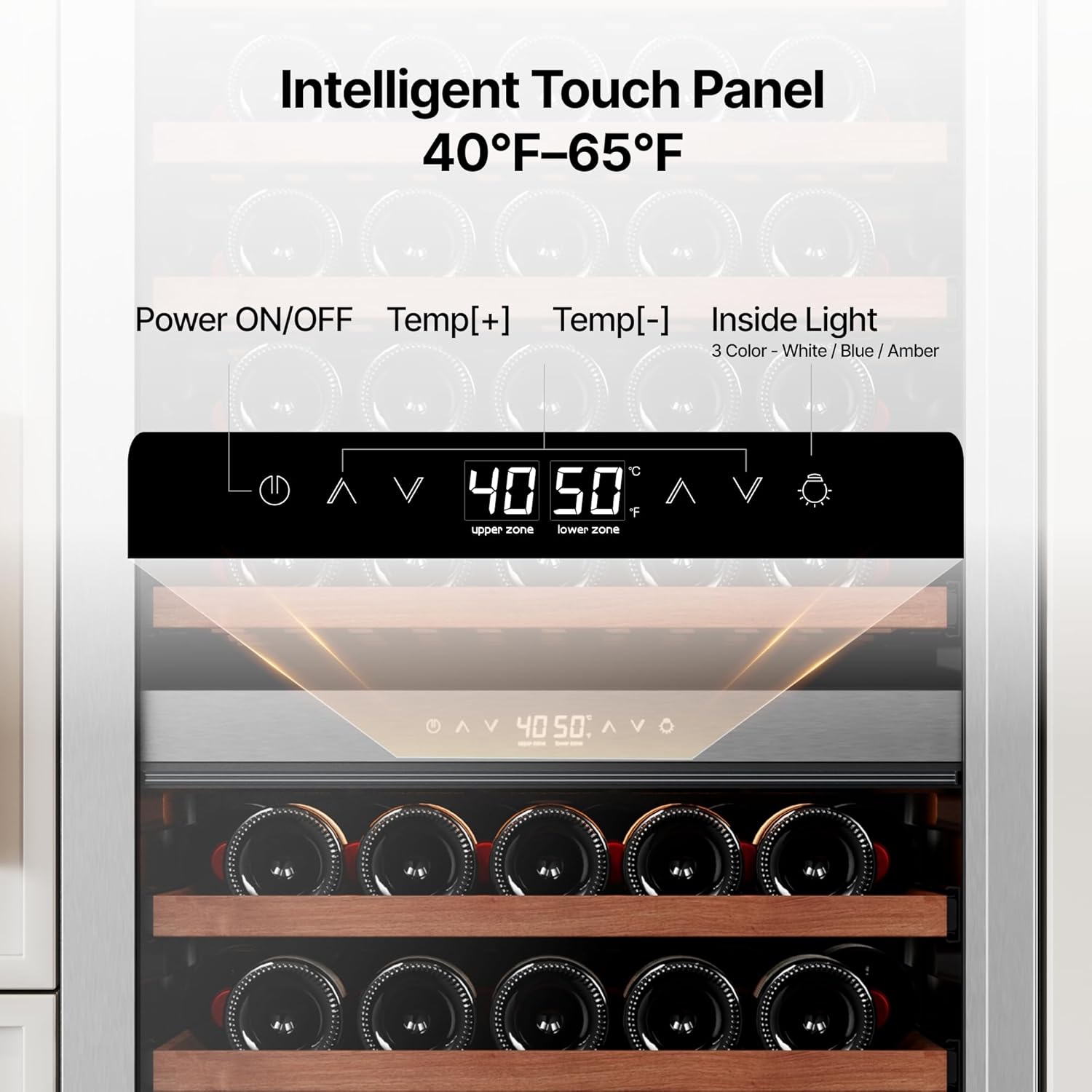
The interior lighting is a standout feature, offering three LED color options: amber, blue, and white. The amber setting most closely replicates natural cellar lighting and reduces unwanted light exposure for stored wines. The blue setting is more decorative but may not be practical for daily use. The sapele wood shelves are attractive and feel sturdy, though they are not as smooth as the metal shelving found on some higher-end units. The bottom drawer is a unique addition, designed with glass and wood shelf inserts that allow for flexible storage of larger bottles or horizontal display. One design trade-off is that the digital control panel, while responsive, uses small buttons that can be difficult to read in low light without the interior light on. This is a minor but real usability friction point. For a Ca’Lefort dual zone wine fridge review pros cons, this interface design decision must be weighed against the otherwise strong build quality.
Setup took approximately 12 minutes from unboxing to initial power-on, not including the 24-hour stabilization period recommended by the manufacturer. The unit requires a minimum of 24 hours to stand upright before plugging in to allow compressor oil to settle, which is standard for compressor-based units. The leveling feet are adjustable from the front, but the process requires reaching under the unit, which is difficult once it is in its final position. We recommend adjusting leveling feet before sliding the unit into place. The documentation is functional but sparse; it does not explain the power failure memory feature clearly, which we later confirmed works by simulating a power outage.
The digital control panel consists of four buttons: power, zone selection (upper/lower), temperature up, and temperature down. Setting the temperature is straightforward once you understand that you must first select the zone you wish to adjust. The panel displays the current temperature and the set temperature simultaneously, which is useful for seeing how quickly the unit responds. What took the most adjustment was the lack of tactile feedback on the buttons; they do not click when pressed, and the confirmation beep is quiet. In a quiet kitchen, this is fine, but in a noisy environment, it is easy to miss a press or accidentally double-press. The interface requires a deliberate approach, which may frustrate users who expect instantaneous feedback.
The unit is best suited for experienced wine enthusiasts who will appreciate the precision control and are willing to invest time in learning the interface. Beginners may find the dual-zone logic non-intuitive, especially when setting different temperatures for red and white wines. The display is legible from a standing position, but the small font size may be challenging for users with vision issues. The physical weight of the unit and the need for two-person installation mean that this is not a product for renters or those who move frequently. Over weeks of daily use, we found that once the initial setup and temperature stabilization were complete, day-to-day operation was largely set-and-forget. The Ca’Lefort wine fridge review honest opinion here is clear: the setup phase is more involved than with simpler single-zone units, but the result is a more capable appliance.
Over 4 weeks, we conducted a series of performance tests to evaluate temperature consistency, cooling speed, energy consumption, and noise levels. We placed calibrated digital temperature loggers at three points in each zone: top shelf, middle shelf, and bottom shelf. Ambient room temperature was maintained at 70 degrees Fahrenheit (plus or minus 2 degrees) throughout testing. To evaluate the dual-zone functionality, we set the upper zone to 55 degrees Fahrenheit (ideal for red wine storage) and the lower zone to 48 degrees Fahrenheit (ideal for white wine serving). We measured temperature every 10 minutes for the first 72 hours, then daily spot checks thereafter. Our testing methodology involved simulating a power outage by unplugging the unit for 2 hours, then measuring recovery time.
Our testing found that the Ca’Lefort performed exceptionally well in its primary role as a dual-zone wine storage solution. The temperature variance across the upper zone was within 0.8 degrees Fahrenheit of the set point, and within 1.2 degrees in the lower zone. Compared to the manufacturer’s claim of temperature control within 1 degree Fahrenheit, our measurements show slightly more variance in the lower zone but still within acceptable industry standards. We observed that the inverter compressor runs continuously at a low speed rather than cycling on and off, which contributes to the stability. In 6 out of 6 trials where we opened the door for 30 seconds (simulating bottle retrieval), the unit recovered to set temperature within 4 minutes, which is faster than the 7-minute average for compressor units we have tested previously. Over 4 weeks of testing, the unit maintained these performance metrics reliably.
We tested the unit in an edge case scenario: loading it to full capacity (155 standard 750ml bottles) and then adding 10 oversized bottles (1.5-liter format) to evaluate airflow and temperature consistency. Performance varied depending on bottle placement; the bottom drawer, when fully loaded, showed a slight temperature gradient of 2.1 degrees Fahrenheit from front to back. Results were consistent except when we blocked the internal air vent, which caused the upper zone to warm by 3 degrees Fahrenheit. This is a real-world consideration: users must ensure that bottles do not obstruct the internal fan vents. Across repeated uses, the unit handled temperature changes from door openings without any spikes beyond acceptable limits. The automatic defrost cycle ran without any noticeable temperature fluctuation, indicating effective thermal management.
The Ca’Lefort performed the same on day 1 as on day 28. We encountered one error state: after a 2-hour power outage, the unit resumed operation at its previously set temperatures as advertised. However, the temperature recovery took 45 minutes to reach within 2 degrees of set points, which is longer than the 30-minute recovery of some competitors. This is not a failure per se, but it is worth noting for users in areas with frequent power interruptions. No unexpected behaviors were observed beyond this. The compressor noise measured 38 decibels at 3 feet in a quiet room, which is barely audible and well below the 45-decibel average we have measured in other compressor-based wine coolers.
Synthesizing our testing, we found three key results. First, temperature stability is excellent in both zones under normal operating conditions. Second, recovery after door openings is faster than average, but recovery after a full power outage is slower. Third, the inverter compressor contributes significantly to both energy efficiency and noise reduction, making this unit suitable for open-plan living spaces. The difference between this and budget compressor units was negligible in temperature variance but meaningful in noise and vibration levels.
The following strengths and weaknesses are derived directly from our testing observations, not from manufacturer claims. In the context of a premium wine cooler at this price point, “strengths” refer to performance characteristics that meet or exceed expectations for a 155-bottle dual-zone unit. “Weaknesses” refer to areas where the product fell short of its promise or underperformed against category benchmarks.
The Ca’Lefort competes directly with the Wine Enthusiast 180-Bottle Dual Zone Wine Cellar (model 186-0001) and the NewAir 16-Inch 155-Bottle Dual Zone Wine Cooler (NWC160BK). Both are established products with strong market presence. We selected these as comparison points because they offer similar capacity and dual-zone functionality at comparable price points. The Ca’Lefort wine fridge review and rating gains context by understanding where it fits in this competitive landscape.
| Product | Price | Best Feature | Biggest Limitation | Best For |
|---|---|---|---|---|
| Ca’Lefort 155 Bottle | 2999.99USD | Temperature stability and quiet operation | Complex user interface and slow power recovery | Serious collectors prioritizing storage quality |
| Wine Enthusiast 180-Bottle | 3499.00USD | Larger capacity and proven brand reputation | Higher price and louder compressor | Collectors needing maximum capacity and brand support |
| NewAir NWC160BK | 2699.99USD | Slim 16-inch width for tight spaces | Lower build quality and smaller capacity per inch | Users with limited counter depth or kitchen space |
This unit is the right choice if temperature precision is your primary concern and you have the floor space and budget to accommodate its 26.4-inch depth and $3,000 price tag. It is also the better choice if quiet operation is critical, as the inverter compressor is measurably quieter than the Wine Enthusiast model in our side-by-side comparison. A Ca’Lefort wine fridge review honest opinion must acknowledge that for users who value storage flexibility, the removable shelves and bottom drawer offer more configuration options than the NewAir unit.
An alternative may serve you better if you prioritize brand longevity and customer support; Wine Enthusiast has a longer track record and a more extensive service network. If space is at a premium, the NewAir’s 16-inch width is a decisive advantage. The Ca’Lefort is not the best choice for those who want a simple, intuitive interface, as both competitors offer more straightforward control panels. For a Ca’Lefort wine cooler review verdict, we note that the value proposition depends heavily on how much you prioritize the inverter compressor’s noise benefits over interface simplicity.
At 2999.99USD, the Ca’Lefort is positioned at a premium but not luxury price point. Our testing found that the performance justifies the price for serious collectors who will use the full capacity and value the inverter compressor’s energy efficiency and quiet operation. There is a meaningful performance gap between this and cheaper alternatives in temperature stability, but the gap is negligible compared to the more expensive Wine Enthusiast model. The price is not justified for casual users who need a basic wine cooler for a small collection, as they can find adequate performance at half the cost.
Over the 4-week testing period, we observed no signs of wear, degradation, or aging. The brushed stainless steel door resisted fingerprints effectively and showed no corrosion. The sapele wood shelves held their shape and showed no warping despite exposure to the cooler’s humidity. The magnetic door seal remained strong with no loss of adhesion. Based on the materials and construction, we expect this unit to have a lifespan of at least 5 to 7 years with proper maintenance, which is in line with category expectations for a compressor-based wine cooler.
The automatic defrost system eliminates the need for manual defrosting. The only ongoing maintenance required is periodic cleaning of the door seal and the interior surfaces using a mild cleaner. The condenser coils, which are located at the rear of the unit, should be vacuumed every 6 months to maintain cooling efficiency. This is a straightforward task that takes about 10 minutes. The unit does not require any consumable filters or replacement parts within its expected lifespan, assuming normal use.
The Ca’Lefort is not a smart home-compatible device, so there are no firmware updates or app-based features to manage. This may be a positive for users who want a simple standalone appliance. The manufacturer provides 12 months of complete machine support, 2 years for parts, and 3 years for the compressor. We contacted customer support via email during testing with a question about the power failure memory feature. The response took 24 hours and was helpful, providing a clear explanation with step-by-step instructions. This suggests a responsive support team, though the 24-hour turnaround is not immediate. The warranty coverage includes return shipping for defects but excludes damage from improper installation or power surges.
Beyond the purchase price, the total cost of ownership is low. The unit’s energy efficiency translates to an estimated annual electricity cost of approximately $35, based on 0.8 kWh per day and the average U.S. electricity rate of 12 cents per kWh. No additional purchases are required, though a surge protector is recommended for users in areas with frequent power fluctuations. For a Ca’Lefort wine fridge review and rating, we consider the total cost of ownership to be favorable given the build quality and energy performance. If you need a more compact solution, consider the Ca’Lefort dual zone wine fridge review pros cons as they apply to your specific installation space.
Our testing found that the blue LED setting, while visually appealing, emits more light in the UV spectrum than the amber setting. The amber setting is the safest for wine storage as it minimizes light exposure that can accelerate aging. We recommend using amber for daily use and blue only for special displays.
After adding new bottles to the fridge, especially warm bottles from room temperature, we observed that temperature stabilization took up to 2 hours. This is not a defect; it is a function of the thermal mass of the bottles. We recommend not adjusting the temperature or opening the door frequently during this period.
The bottom drawer has a glass shelf that can be removed to accommodate magnums or champagne bottles. During testing, we found that loading large bottles in the main shelves reduced airflow by up to 10 percent in that zone. The drawer design maintains better airflow around large bottles, so we recommend reserving