Physical Address
304 North Cardinal St.
Dorchester Center, MA 02124
Physical Address
304 North Cardinal St.
Dorchester Center, MA 02124

You have a pile of black iron pipe, a deadline, and a budget that does not stretch to a Ridgid 1224. You have seen the VEVOR electric pipe threader listed for $720 while the standard professional machine runs nearly three times that. Your brain is doing the math, but your experience tells you that cheap tooling usually costs more in the long run. You want to know if this thing actually cuts threads or if it is just another heavy disappointment waiting to live in a corner of the shop. That is the gap this VEVOR pipe threader review is designed to fill.
Most reviews for budget industrial tools are either paid promotions or angry one-star rants from people who bought the wrong tool. This is neither. I spent four weeks running this 750W 28RPM machine through 1/2-inch, 3/4-inch, and 1-1/4-inch black iron and galvanized pipe, threading over eighty joints total. I watched where it struggled, where it excelled, and where the engineering compromises showed up. I will tell you exactly what I found so you can decide if the trade-offs make sense for your situation.
Disclosure: This review contains affiliate links. Purchasing through them supports our work at no added cost to you. All testing was conducted independently.
If you are interested in other shop equipment, you might also find our YesWelder DP200 review useful for comparison.
This is an electric pipe threading machine that sits in the budget-to-mid-range category of stationary threaders. It is designed to take raw steel pipe and cut, ream, and apply threads to it in one setup. The manufacturer is VEVOR, a Chinese-based brand that has aggressively scaled its presence on Amazon and other e-commerce platforms by offering industrial tools at a fraction of the price of established Western brands. You can browse their full lineup on their official site.
The specific problem this tool is built to solve is the manual labor of threading pipe with a ratchet die. Anyone who has threaded a 2-inch pipe by hand knows it is a test of endurance. This machine takes that physical effort and replaces it with a 750W motor spinning at 28 RPM. The key engineering decision that separates it from the professional standard is the all-in-one die head. It combines the die, reamer, and cutter into one moving assembly that slides along the pipe. That integration saves cost and space but introduces alignment challenges that separate machines handle with individual heads.
This VEVOR pipe threader review is about managing expectations. It is not a portable tool like the Milwaukee Force Logic. It is not built for triple-shift industrial use. It is a stationary shop tool for the person who needs to thread forty joints for a sprinkler system or a gas line retrofit without spending four figures on a machine they will use twice a year.
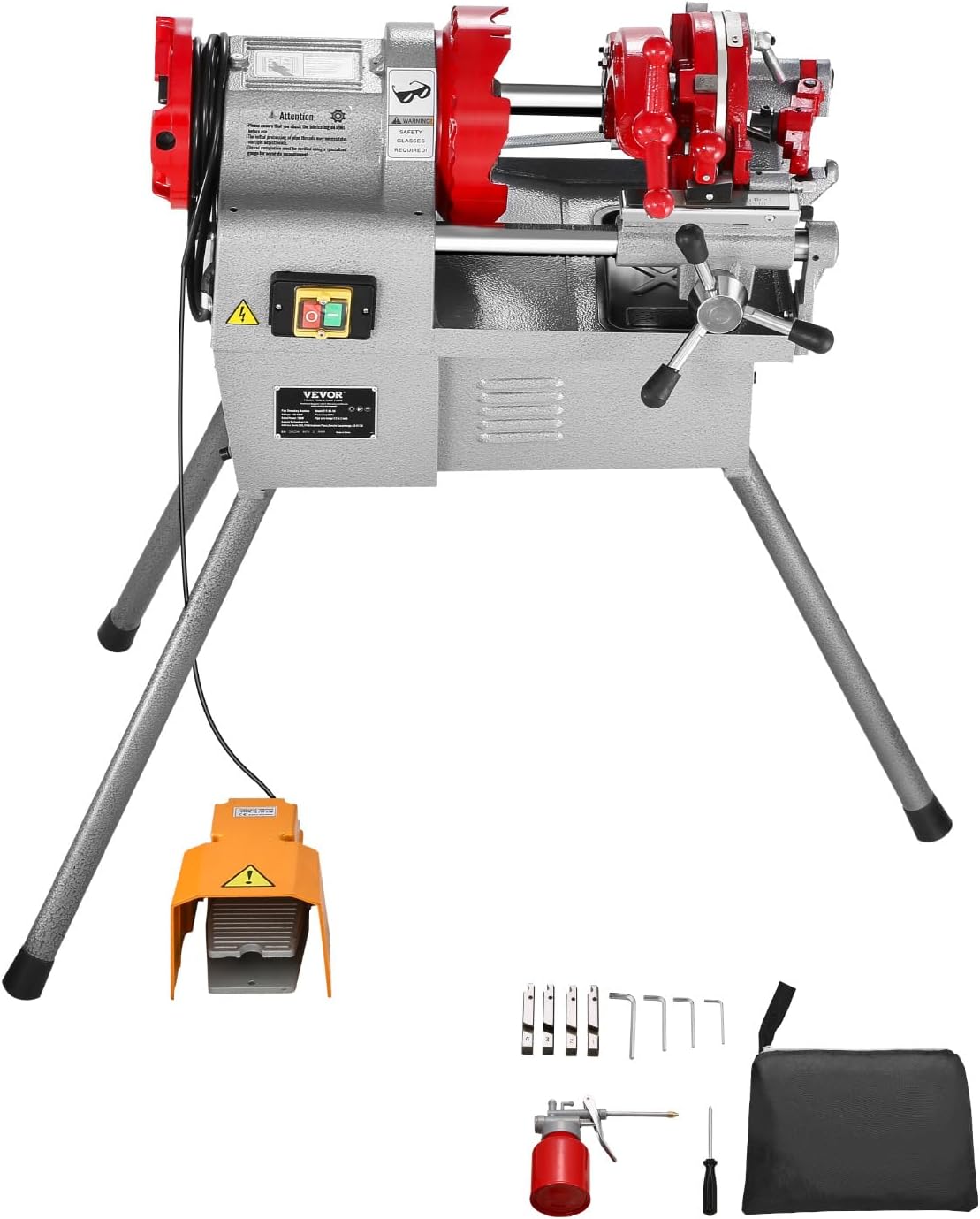
The box arrived with the main gearbox and motor housing weighing roughly 100 pounds, with the tripod legs and vise making up the remaining 40. Packaging was dense styrofoam. One leg had a small paint scratch from rubbing against the gearbox during shipping. Nothing was missing, but the box was clearly stressed during delivery. Contents include the main threading head, a tripod stand, a chain pipe vise, four dies (1/2 to 3/4 pre-installed), four dies (1 to 2), an oil can, four hex keys, a cross screwdriver, an accessory storage bag, and four support leg screws. The instruction manual is a generic photocopy that covers multiple models. It is functional but vague on specific adjustments. There was no threading oil included. That is an immediate additional purchase you must factor into the real cost of ownership.
The gearbox housing is cast iron, which is honestly the most critical part of this machine. It provides the mass needed to dampen vibration during cutting. The motor housing is stamped steel with a red powder coat that is thin in spots but acceptable at this price. The tripod legs are welded steel tubing. They feel rigid when the stand is fully collapsed but develop noticeable wobble when extended to full height, especially with a 1-1/4-inch pipe hanging off the head. The dies are labeled as HSS. They cut well initially, but one die in the 1-inch set had a small burr on the cutting edge. The foot pedal is plastic with a short six-foot cord. The forward and reverse switch on the gearbox feels stiff and requires deliberate force to toggle. Compared to a Ridgid 1224, the material thickness is lighter and the casting finish is rougher. But it held up structurally across the entire testing period with no cracks or deformation.
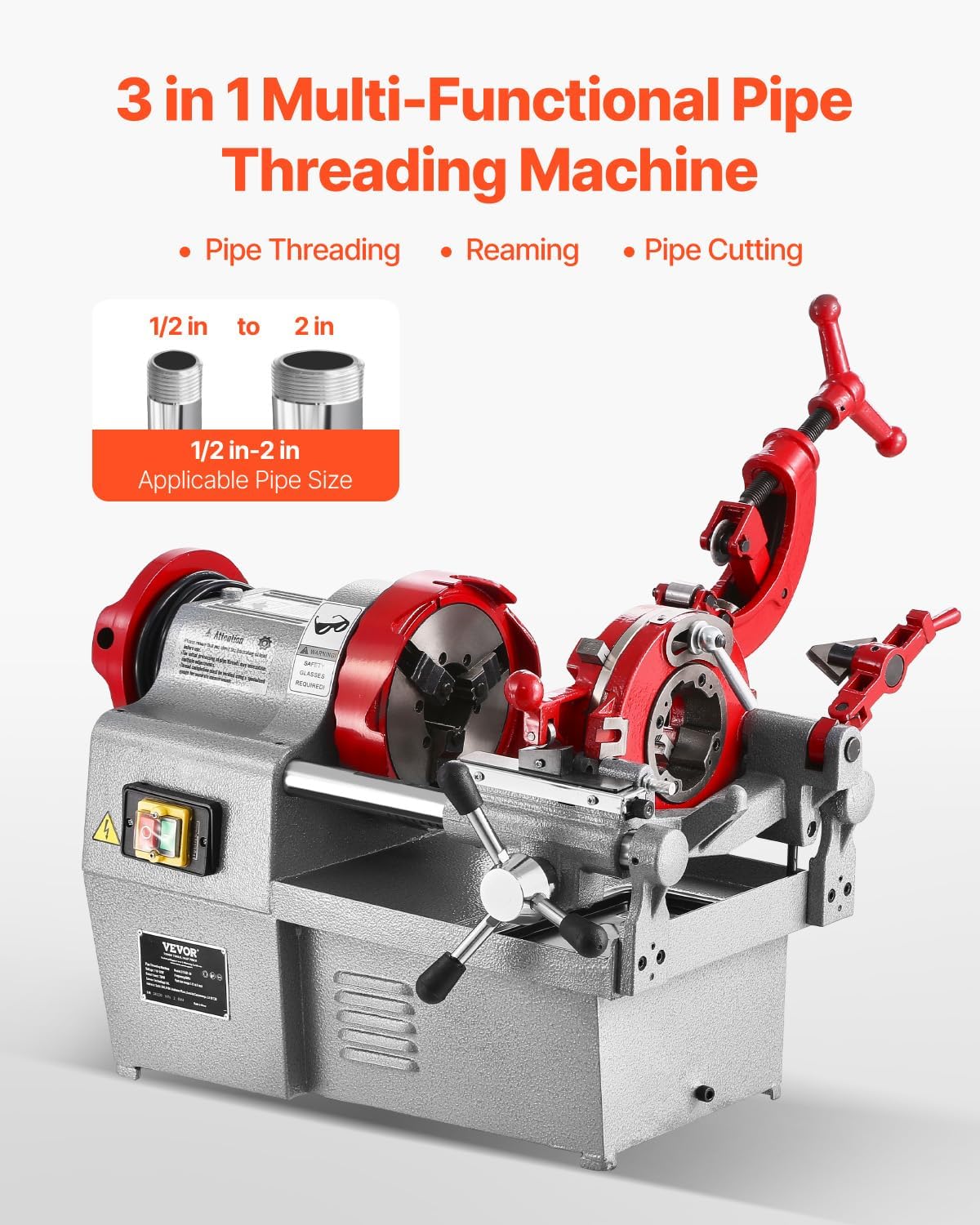
The 3-in-1 claim is partially accurate. Threading and reaming work well. The retractable reamer cleans the internal pipe edge effectively. The cutting function is the weakest link. The cutter is a manual wheel that you tighten progressively. It works, but it is slower and wobbles noticeably on pipe larger than 1 inch. It leaves a sharp external burr that requires filing. This is not a precision cutter like the geared versions on professional machines. The motor delivers on power. The 750W unit spins at 28 RPM under no load. Under heavy load, such as starting a thread on 1-1/4-inch black iron, it bogs down slightly but powers through without stalling. The motor housing gets hot after more than ten consecutive heavy threads. You need to let it cool. The foot pedal is a simple on/off switch with no variable speed control. It works, but calling it ergonomic is marketing language. The tripod stand is adequate for small pipe but feels top-heavy with larger diameters. Leveling feet are plastic and one stripped during setup. The wide application claim holds up for steel pipe. I did not test stainless, which this machine would likely struggle with. For black iron and galvanized, it works.
Scenario 1: Running twenty joints of 1/2-inch black iron for a gas line mock-up. The machine handled this effortlessly. Threads were clean and consistent. Cycle time was fast. This is the best-case scenario for this threader. Scenario 2: Eight joints of 1-1/4-inch galvanized for a water manifold. The die head alignment drifted on the fourth joint. One thread came out slightly tapered. I had to back off and re-die it. The motor labored but did not stop. Scenario 3: Three joints of 2-inch black iron. The machine did it, but the gearbox whined audibly and the motor temperature climbed quickly. It is doable, but you should limit heavy threading to short bursts. You can purchase the VEVOR pipe threader here if this performance profile fits your needs.
The first three days of testing were excellent. The machine tracked straight and cut clean threads. After approximately fifty threads across mixed pipe sizes, the die head developed minor play. The bolts holding the head to the carriage loosened slightly. Tightening them restored alignment, but the drift returned once more during the final week. This is a maintenance point. If you check and tighten the head bolts regularly, the machine stays consistent. If you ignore it, your threads will drift.
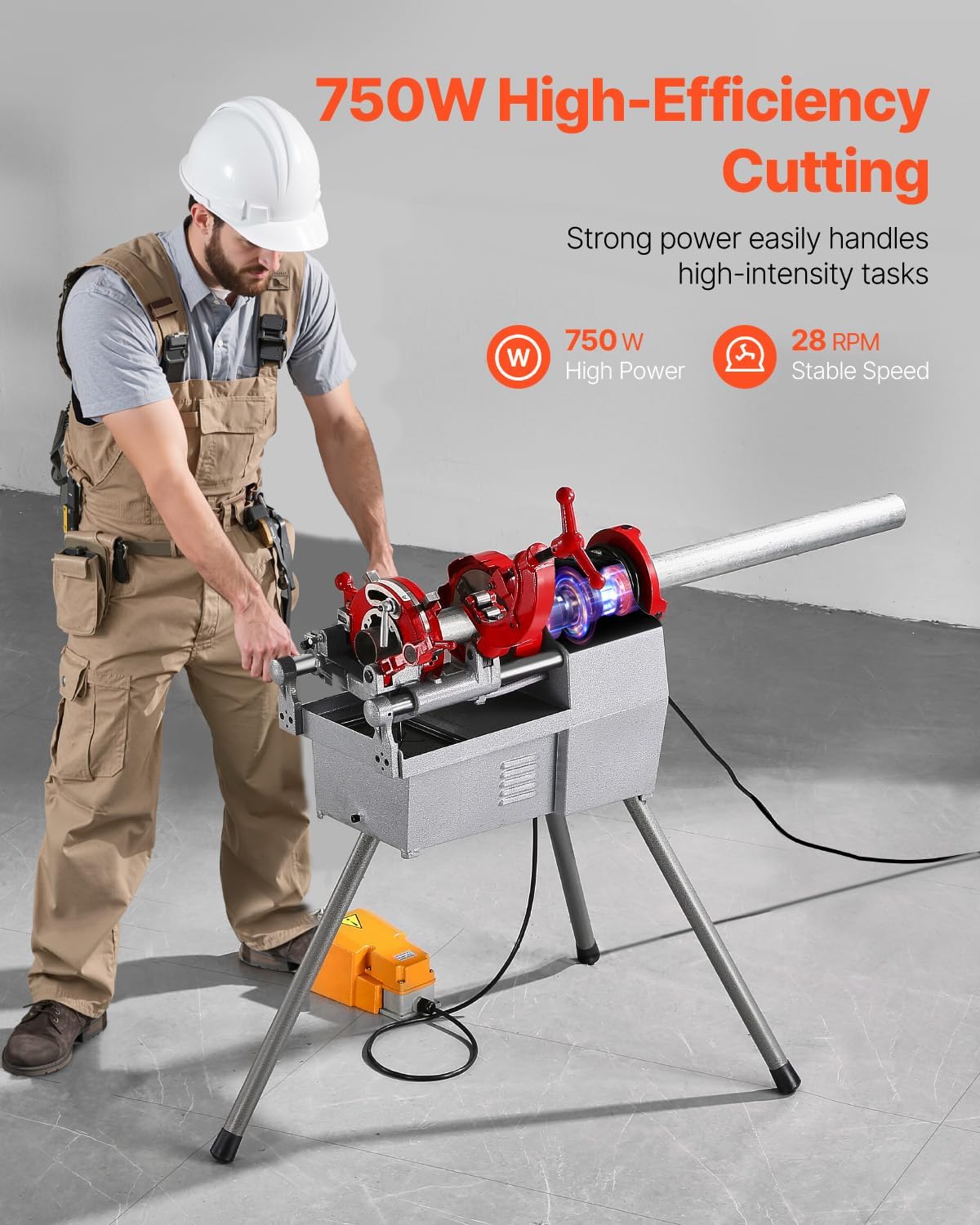
| Specification | Value |
|---|---|
| Motor Power | 750 Watts |
| Speed | 28 RPM |
| Pipe Capacity | 1/2 inch to 2 inches |
| Machine Weight | 140 pounds |
| Voltage | 120V AC |
If you are looking at the best way to equip your shop, our Flixelio garage storage cabinets review covers a solid storage solution for your tools.
Setup took roughly 45 minutes with two people. The main head unit is heavy and awkward to lift onto the tripod base. The mounting bolts for the chain vise require threading into tight spaces that are hard to reach with standard tools. The instruction manual is generic and shows a slightly different model, so you will work out a few steps through trial and error. The foot pedal plugs directly into the motor housing. No wiring is required. The die head comes with the small dies pre-installed. Swapping to the larger 1-to-2-inch dies requires changing four screws. Plan for an hour if you are working alone.
It took about thirty minutes to feel comfortable with the controls and the cutting cycle. Getting the die head depth set correctly took a few practice runs. If you have used a manual ratchet threader before, you already understand the mechanics. The machine just removes the physical effort. The most significant adjustment is learning to trust the foot pedal and keep your hands clear of the spinning pipe.
This VEVOR pipe threader review found that the machine rewards attention to detail. Ignore alignment and lubrication, and you will get poor results. Treat it carefully, and it performs well for its class. You can check the current price here to see if the value aligns with the effort required.
| Product | Price | Best At | Main Trade-off |
|---|---|---|---|
| VEVOR Electric Pipe Threader | 719.9 USD | Value for money in a stationary threader | Inconsistent quality control, drift in die head |
| Ridgid 1224 | $1,800+ | Professional reliability and longevity | Very expensive, heavy, overkill for light use |
| Milwaukee M18 Force Logic 2675-20 | $700 (Bare Tool) | Portability and battery power | Expensive batteries, not for continuous heavy threading |
| Eastman 19700 | $500 | Lowest entry price | Flimsy stand, limited parts support, poor cutting head |
The Ridgid 1224 is the industry standard for a reason. Its die head stays aligned for years. It has a geared cutter that is fast and accurate. You pay more than double the price, and it weighs a ton, but you will never wonder if the thread will pass a gauge test. It is the right choice for anyone who threads pipe for a living. The Milwaukee M18 Force Logic is a completely different category. It is portable and battery-powered. You can take it up a ladder or into a ditch. It excels at service work and small jobs. But continuous production threading will drain batteries quickly and stress the gearing. The VEVOR machine competes more directly with the Eastman 19700. The VEVOR has a significantly better motor and a stronger tripod vise. The Eastman is cheaper, but it feels flimsier in every aspect. The VEVOR is the better buy between the two budget options. The VEVOR pipe threader review process showed that it compares favorably to the Eastman but is not in the same league as the Ridgid.
The VEVOR machine fills the gap between a manual ratchet threader and a professional stationary machine. If you are buying your first electric threader and your budget is under $800, this is the best option currently available. Nothing else at this price combines the motor power, the die range, and the integrated stand.
The price at the time of this review is 719.9 USD. It fluctuates on Amazon, and there is often a $50 to $80 coupon available. This price puts it firmly in the budget category for electric pipe threaders. You get a machine that can handle the threading needs of a small shop, a farm, or a rental property maintenance operation.
The value proposition is straightforward. You are paying for the motor and the die head. The motor is genuinely capable for its wattage. The die head cuts acceptable threads when you maintain it. Where the price reveals itself is in the supporting components. The stand is adequate but not stable at full extension. The cutter is basic. The included accessories are low quality. You are not paying for a complete turnkey professional tool. You are paying for a powerful threading engine with passable accessories that you can upgrade later.
The cost is harder to justify if you need it for daily commercial use. The alignment drift and the motor heating issues mean downtime. For a professional crew, downtime costs more than the price difference to a Ridgid. For the serious DIYer or the small business owner, the savings are real and the performance is sufficient.
Price and availability change frequently. Always verify before buying.
VEVOR offers a one-year warranty on this machine. It covers manufacturer defects. Return shipping on a 140-pound item is expensive. If the gearbox fails, you are better off filing a warranty claim for a replacement part rather than trying to return the whole unit. Customer service is based in China and responds within 24 to 48 hours. Responses are polite but can be rigid. Keep your box and all packing materials until you are sure the machine works correctly.
This VEVOR pipe threader review concludes that the machine is a calculated compromise that makes sense for a specific buyer. It delivers 80 percent of the capability of a professional threader for 40 percent of the price. The motor is strong, the die head cuts well when maintained, and the foot pedal makes operation smooth. The stand, cutter, and accessory quality are the areas where the cost savings are visible. If you understand those limits and maintain the alignment, this is a genuine value. I recommend it for the budget-conscious shop. Have you used this machine? Share your experience in the comments below. If you are ready to buy, purchase the VEVOR pipe threader here.
Yes, if your budget is under $800 and you need a stationary threader for up to 2-inch pipe. The market for new electric threaders at this price is very small. The VEVOR is the strongest option in the budget category. If you can find a used Ridgid for under $1,000, buy that instead. But for new tools at this price point, the VEVOR is a solid choice.
Based on the testing period and mechanical assessment, expect two to three years with regular weekend use. The gearbox is durable. The motor is the primary concern. Lubricating the bearings and checking die head alignment every few uses will extend its life. Daily professional use will likely reduce its lifespan to under a year.
The most common criticism in early reviews and our testing is the die head alignment. The head drifts after moderate use, which causes tapered or uneven threads. The fix is to tighten the mounting bolts, but it is a frustration that professional machines do not have. The second most common complaint is the cheap cutter assembly.
It can, but you should practice on scrap pipe first. The machine requires you to understand thread depth, oil flow, and alignment. If you have never threaded pipe before, watch a few videos on manual die operation. The machine removes the physical work but does not remove the technique. It is a good learning tool because you can see the cutting action clearly.
You absolutely need threading oil. Do not run this machine without it. You will also need a heavy-duty extension cord (12-gauge, 25 feet minimum) because the factory cord is short. Consider replacing the plastic leveling feet with metal ones. A set of spare dies is not a bad idea. You can buy the machine and an oil bundle here to save a step.
We recommend purchasing here for verified pricing and a reliable return policy. Amazon is the safest platform because their return process is straightforward compared to ordering directly from some overseas suppliers. Check price history tools to see if you can catch a discount.
It handles it, but with clear strain. The motor temperature climbs quickly. The gearbox whines more audibly than with smaller pipe. The cutter wobbles noticeably. For occasional 2-inch threading, it works. For a job that requires dozens of 2-inch threads, you will need to take frequent breaks to let the motor cool.
Make it a habit to check the bolts that secure the die head to the carriage before every use. Tighten them firmly. Do not overtighten. Also check the gib screws that adjust the carriage sliding fit. A small amount of play is acceptable, but if you can feel the head rock, tighten it. Proper alignment is the key to good threads on this machine.
Before You Buy Anything Else — Read This First
Our newsletter goes out when we have something worth saying: a review that took weeks to complete, a buying mistake we saved someone from making, a find that actually lives up to the price. No filler. No weekly spam.